Easter Breads Around the World
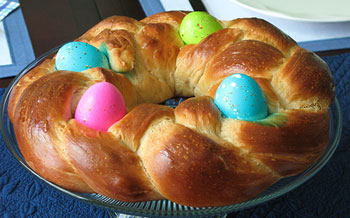
Italian Easter Bread
Spring is time for the beautiful breads of Easter. These rich, festive breads are steeped in history, folklore, and symbolism. Originally baked as a tribute to the end of winter's sparse fare and later associated with the celebrations that followed periods of religious fasting, Eastern Europe has one of the richest repertoires of Easter breads.
Easter's light, yeast-risen loaves are abundantly laden with luxurious ingredients, such as almonds, candied citrus peel, and precious spices like cinnamon and saffron. Easter breads always are very rich, since they are meant to contain all the foods which were removed from the Christian’s diet during Lent: butter, eggs and milk. All these breads would be welcomed heartily by those breaking the seven-week fast, and they are truly wonderful! The approach to holiday bread baking is one that sanctions us to lavish the loaves with extra care.
Easter breads originated from ancient European, Byzantine, and Orthodox Christian traditions, primarily within Central and Eastern Europe and Italy. Traced back to "honey-leavened" bread from the Homeric Greek period, these breads evolved into symbols of new life, with ingredients like eggs and butter representing the end of Lent.
"Easter has always had a close association with food. The word comes from the name for the Anglo-Saxon goddess of light and spring, Eostre, and special dishes were cooked in her honour so that the year would be endowed with fertility. Most important of these dishes was a small spiced bun, from which our hot cross bun derives but from which also the traditional spicy sweet bread of Greece probably had its origins.
"The baking of buns associated with religious offerings goes back to remotest antiquity. The Egyptians offered small round cakes to the goddess of the moon, each marked with a representation of the horns of an ox, which were her symbol. In ancient Greece, a similar small, sacred bread containing the finest sifted flour and honey, had the name bous meaning "ox" and from which the word bun is said to have originated. In time, the representation of the horns became a simple cross, although it also has been suggested that this was intended to symbolise the four quarters of the moon.
"The old association of protection and fertility, and thus birth and rebirth, was transposed into a Christianised form and the ritual of baking "hot cross buns" became standard practice of the Easter celebration in English society. In the Baltic region of Russia, their Easter cake is kulich, a yeast dough of enormous proportions lavishly decorated with crystallised citrus peel. In traditional households it is presented on a table decorated with decorated eggs and the younger members of the family visit to share the eggs and bread."
---"An ancient tradition," J. Passmore, Courier Mail (Queensland, Australia), March 26, 1997, LIFE; Pg. 40
Easter breads are customarily decorated with colored eggs, drizzled with icing, studded with bits of candied and dried fruit, divided into ropes of dough and elaborately braided into rounds, or stuffed with rich fillings. While the ancient meanings surrounding the ingredients and design of these celebratory breads are based on Easter and springtime traditions, the magnificent loaves that result, with their fine crumb and sweet flavor, are treats that can be savored throughout the year.
Representative of these special foods are the numerous Easter breads, many of which share similiar flavors and symbolic shapes, such as the cross. This can be seen in the English Hot Cross Buns. A cross made of dough also tops Portuguese sweet bread, under which they tuck a raw, untinted egg.
Eggs, an ancient symbol of life, are another common thread between the bread recipes from various countries. The Italians tint and tuck them into the almond- and anise-flavored dough of their Easter bread. Eastern Orthodox Greeks prepare Tsoureka, flavored with mahleb, a Persian spice made from the ground seed of a wild, cherry-type fruit that gives a distinctive perfume-like flavor to the baked bread. Once again, nestled into the dough are hard-cooked eggs that have been dyed red with a special coloring agent. Often braided to represent the Holy Trinity or the crown of thorns, they incorporate eggs symbolizing the resurrection.
- The cylindrical shape of Finnish Easter bread and Russian Kulich is achieved by baking the dough in coffee cans. The top of Kulich is frosted to resemble a church dome covered with snow.
-
Czechs bake Easter buns called velikono pecivo.
-
German Easter bread comes in three shapes, their Easter braid (represents the Holy Trinity - three strands, one bread), Osterzopf, and Easter wreath (represents Eternity and renewal; no beginning, no end), Osterkranz. The round loaf (represents the sun; Jesus as the light of the world) is called Osterbrot.
-
Italy abounds in regional Easter breads, from Genoa's pan dolce to Venice's fugassa di Pasqua buns.
Also see http://www.kitchendaily.com/encyclopedia/definition/easter-foods/827/
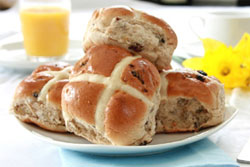
England's Hot Cross Buns
A traditional favorite on Good Friday in England, Hot Cross Buns are a spicy currant or raisin studded yeast bun, topped with a "Cross" of icing. While Christians have adopted the cake and the symbolism of the cross, it wasn't always so. To Pagans, then as now, the cross is representative of the sun wheel, which symbolizes perfect balance at the time of the Spring Equinox.
Today, they are traditionally baked and eaten on Good Friday, the Friday before Easter Sunday that marks the crucifixion and death of Jesus. Each element of the hot cross bun has a religious significance, particularly their signature cross, which represents the crucifixion of Jesus Christ. The spices used in the buns are believed to represent the spices used to embalm Jesus. Some believe the raisins represent the body of Christ in the tomb. The sweetness of the buns, especially the sugar in the cross, is seen as a representation of the resurrection.
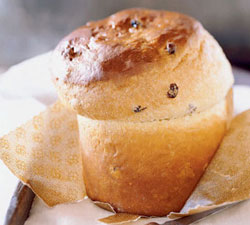
Polish & Ukrainian Babka/Baba
With its rich ingredients of eggs, butter, and raisins, Babka rises high and golden above the daily bread. The name is derived from the Polish word for "grandmother" (babka/baba). In its native Ukraine and Poland, a traditional blessing readies the loaf for the Easter table.
Note: Babka should not to be confused with Paska, the Ukrainian name for Easter bread, although they are closely related. In many Ukrainian traditions, paska is considered the main, sacred bread, while babka is a similar cousin. Some families use the names interchangeably, while others maintain distinct differences based on regional traditions.
A Polish babka, is in fact nothing more than a brioche translated to Poland. We know that there was much back and forth between France and Poland when a Polish-born queen ruled in France, and it is no surprise to find the famous Polish babka a sister to the brioche. More eggs are used than in a brioche dough, though, and the recipe delays the addition of butter until after the first rise to enable the yeast to work to its full effect. Hence a baba is lighter and spongier than a brioche, with an open texture that makes it ideal for soaking up the syrup or liquor added after cooking (to many its chief attraction).
Traditional babka has some type of dried fruit filling, especially raisins, and is glazed with a fruit-flavored icing, sometimes with rum added.
Note about Savarin: The savarin derived from the E. European baba, was naturalized in Alsace in the 18th century. What happened was that in the mid- or late 1840s one of the brothers Julien, Parisian pâtissiers, experimented with the baba in a slightly different form. He used the same dough, but removed the dried fruits and soaked the savarin with his own 'secret' syrup. He named his new confection in honour of the famous gastronomic writer Brillat-Savarin, although this name for it does not seem to have been recorded until the 1860s.
Traditional Easter Babka Recipe - Polish Babka Wielkanocna (uses 15 egg yolks!)
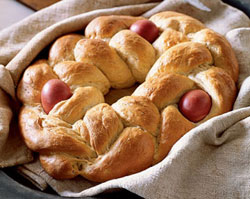
Greek Tsoureki
It seems likely that the bread from Greece, Tsoureki, is one of the oldest of Easter breads. It is made to hold red-dyed Easter eggs, a symbol of the religious season. It is believed that Mary Magdalene traveled to Rome to go before the Roman Emperor and present him with red eggs, which she used to explain the Trinity. In any case, red-dyed eggs are very popular in both Russia and Greece at Easter time.
The traditional flavoring for the bread is a spice called mahlep, a spice derived from the ground pits of a particular cherry. In a pinch you can substitute vanilla, but the mahlep is worth finding. It adds a distinctive cherry/almond, sweet-nutty flavor that's unlike anything you've tried before.
Lambropsomo is a variation.
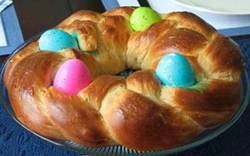
Italian Easter Bread (Pane di Pasqua/Treccia)
Traditional Italian Easter bread, known as Pane di Pasqua, is a soft, sweet brioche-style braided bread, often shaped into a wreath, representing the crown of thorns, and studded with dyed, hard-boiled eggs that bake along with the dough. Typically, it is flavored with anise and citrus, and topped with icing and sometimes sprinkles.
Pane di Pasqua can be made either as one large, festive braided wreath or as smaller, individual-sized breads, with both methods traditionally including dyed, hard-boiled eggs. Small wreaths are often made to create individual portions, while one large wreath acts as a table centerpiece.
Another iconic, sweet, dove-shaped bread, popular nationwide, is the A Milanese sweet bread, Colomba Pasquale (Easter Dove), which is similar to Christmas panettone. It is made with flour, eggs, sugar, natural yeast, and butter, topped with pearl sugar and almonds.
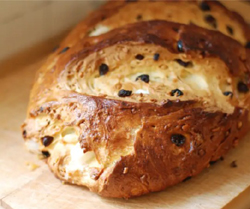
Aachener Poschweck (German Easter Bread with Raisins and Sugar Cubes)
In the heart of Europe, tucked between the borders of Germany, Belgium, and the Netherlands, lies Aachen, a historic city known for its thermal springs, stunning architecture, and rich cultural heritage. Aachen is also the birthplace of a delectable culinary treasure: the Aachener Poschweck. Aachener Poschweck, also known as Achener Easter Bread, is a traditional German sweet bread. It’s a popular treat during Easter and is often given as a gift to friends and family.
The Aachener Poschweck has been enjoyed by locals for centuries, with the first recorded mention in 1450. Originally, it was baked as a special treat to be consumed on Easter Sunday. Its name stems from the local dialect, with “Posch” meaning “Easter” and “Weck” referring to “bread roll” or “loaf.” The bread has been made in Aachen for centuries, and each family has their own recipe and method for making it. Some families even pass down their recipe from generation to generation, making it a cherished family tradition.
The bread is made from a rich dough that’s flavored with raisins, almonds, and sugar cubes which caramelize during baking. What sets Aachener Poschweck apart from other sweet breads is the combination of flavors and textures. The caramelized sugar cubes give it a rich, sweet taste, while the raisins and almonds provide a chewy, crunchy texture.
Aachener Poschweck (German Easter Bread)
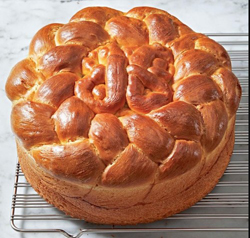
Paska (Ukrainian Easter Bread)
Paska bread, an egg-enriched bread with a beautiful braided top, is an Easter staple in Ukraine. This Paska bread recipe is a traditional brioche dough recipe, enriched with egg yolks and sugar, then studded with golden raisins and baked up. The raisins are optional.
Paska is a traditional Easter bread from Ukraine and eastern Europe. In Russia, this sweet, eggy bread is called Kulich. It's most often made in the spring to celebrate Easter. The word Paska translates to “Easter” in most eastern European cultures.
Paska (Ukrainian Easter Bread)
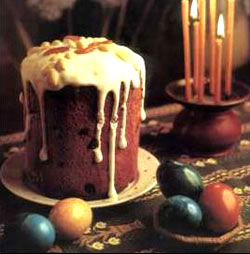
Russian Kulich
A cross between brioche and challah, this bread, called Kulich, is a lightly sweetened, egg-glazed cylinder, often baked in a coffee can to make a tall loaf. The shape is Slavic and of great antiquity. The kulich is based on a baba dough, with more sugar, plus additions of candied peel, almonds, raisins, and saffron. The bulging top is frosted to resemble a church dome covered with snow and decorated, usually with Cyrillic letters XB standing for 'Christ is risen'.
The kulich would sit proudly in the center of the family Easter basket, surrounded by meats, cheeses, butter, and eggs. It's a central part of the Easter meal, and always served with sweet Paskha, the famous Russian sweetened cheese confection based on curd cheese and similar to cheesecake.
Kulich is only eaten between Easter and Pentecost.
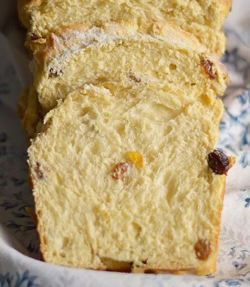
Lithuanian Easter Bread (Velykos Pyragas)
This is a Lithuanian Easter bread that contains little bursts of sweetness from the addition of golden raisins. Like many Easter breads, the dough is soft, fluffy and buttery. It’s traditionally baked in a loaf pan. Velykos Pyragas is a variation on the traditional Kulich, the Russian Easter bread.
Lithuanian Easter Bread - Velykos Pyragas
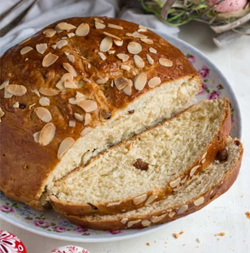
Czech Sweet Easter Bread (Mazanec)
When it comes to traditional Easter treats in the Czech Republic, one must not forget Mazanec, a sweet and festive Easter bread. Also known as Velikonoční bochánek, it is one of the most beloved symbols of Czech Easter. The dough is very similar to that used for Czech Vánočka, or Houska Christmas bread. However, mazanec is not braided, which makes it just a little easier to prepare.
Czech Sweet Easter Bread (Mazanec)
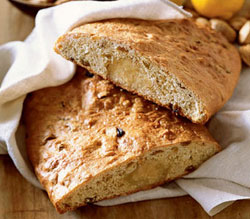
Dutch Paasbrood
Almonds ground into a sweet paste supply the signature filling in a Dutch Paasbrood. This traditional Easter loaf from the Netherlands is filled with a sweet almond paste and studded with golden raisins and candied lemon peel. The bread is similar to Stollen.
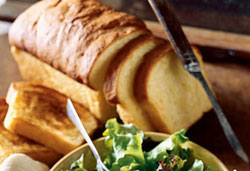
Portuguese Pao Doce
Fragrant saffron is traditionally added to Pao Doce — the lightly sweet, golden loaf of Portugal.
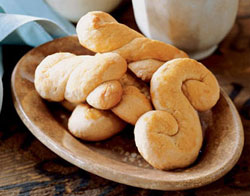
Greek Easter Morning Biscuits
In Greece, Easter bread traditions abound. Our Easter Morning Biscuits, with their twisted and serpentine shapes, are a take on one Greek favorite, Koulourakia. These crisp, honey-sweetened biscuits originate from Ikaria — a rustic Greek Island in the Aegean Sea — and are a frequent feature at an Easter feast. The biscuits are made from a simple non-rising dough — similar to cookie dough — that makes it possible to put these treats on the Easter breakfast table with little effort and time. Serve them with a steaming cup of strong black coffee — they're ideal for dunking.
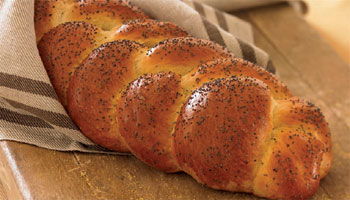
Jewish Challah
This rich, eggy, slightly sweet yeast bread exists in almost every culture. Bohemians and Czechs call it houska, Poles, who call it chalka, adopted it from their Jewish countrymen who refer to it as challah, and on and on. Leftovers make great French toast and bread pudding.
While Challah is a Jewish braided egg bread typically baked for Sabbath and holidays, it is not traditionally part of Easter (the Jewish faith does not recognize Easter), though it is frequently baked around that time by non-Jewish bakers. It can be used for Easter breakfast or brunch. Importantly, Challah is not eaten during Passover, which often overlaps with Easter, as it is leavened bread.
Challah - excellent recipe
See also Czech Christmas Bread (Vanocka, Christmas variation of houska)
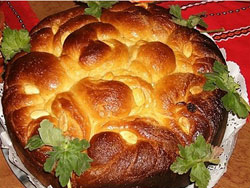
Bulgarian Kozunak
This Bulgarian bread, known as kozunak, is featured at Christmas, Easter and other special occasions. It is an egg-rich braided loaf stuffed with rum-soaked raisins.
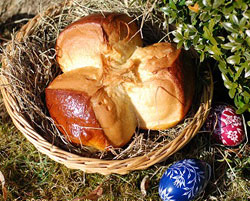
Italian Pinza
Most of the Christian Mediterranean cultures have some form of rich, festive egg bread that they prepare for the Holy Week before Easter. Baking Pinza is a tradition that is still strong in the Veneto region of Italy. The panettone and colomba cakes often found in the country today are derivatives of pinza.
Making good pinza requires some understanding of leavening and bread making. It also requires patience, because the dough, rich with eggs and butter, requires several long risings.
Serve slices of pinza with espresso, tea, or, in the morning, with caffè latte. For a richer dessert, top with whipped cream or mascarpone and berries, or enjoy it as is on a wonderful festive table or for brunch on Easter Sunday. The loaves keep well for one week at room temperature if sealed in plastic wrap, for six to eight weeks in the freezer. For the effort, it pays to make a larger quantity and enjoy for weeks after.
http://www.epicurious.com/recipes/food/views/Easter-Bread-106188
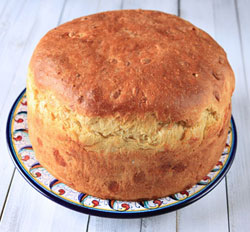
Italian Crescia (Umbrian Cheese Bread)
Crescia al Formaggio, a traditional Easter bread from Umbria, is still mostly unknown in this country, and that's a pity. This light-textured, golden egg bread, loaded with Parmesan and Romano cheeses, perfumes the kitchen with its wonderful savory aroma as it bakes. A nice change from the usual Easter sweet breads, it goes wonderfully well with the Easter ham-both at dinner, and later, when you're making those yummy ham and cheese sandwiches (plain or, even better, grilled). It is also great toasted for breakfast with eggs, and goes really well with cured meats and salami. This bread is very impressive to look at as it rises to a tall golden dome and is flecked with pieces of cheese.
