Wafers
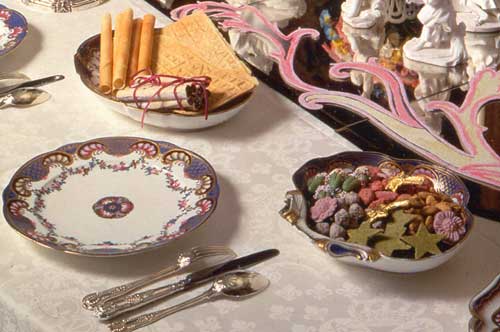
Flat and curled wafers. Those that are tied are cannelons
which are filled with chocolate and fruit pastes.
During the late medieval period and into the early renaissance, wafers were an important constituent of the void, or issue de table , the court ceremony at the end of a state meal. Wafers, comfits and hippocras were consumed by the sovereign in this semi-religious ritual linked with the final grace and the washing of hands. The hippocras and wafers may originally have had a quasi-eucharistic significance in that they echoed the Holy Communion. The spicy comfits were intended as 'stomach settlers' to calm the royal digestion, though like both hippocras and wafers they later became luxurious treats consumed at all manner of celebratory occasions by those who could afford them.
Wafers continued to be an important element of the dessert course in later centuries. The 1766 French dessert to the right has both curled and flat wafers and cannelons (a type of wafer tube) filled with chocolate and fruit pastes. The cannelons are tied together with ribbon.
Some unusual wafers, unique in the history of English food, were flavoured with bergamot and barberry. The recipes were written by the Georgian confectioner Frederick Nutt (1789). These delicious wafers were made by anointing wafer paper (similar to modern rice paper) with a mixture of sugar, egg white and citrus juice and then allowing the heat of a cool oven to curl them round a stick. A special utensil was used to achieve this. The finished result is the lightest and most delicious wafer ever eaten.
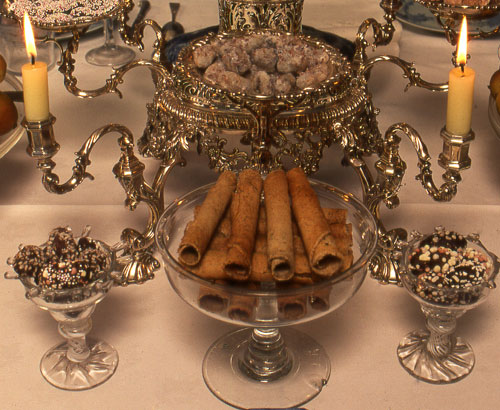
Rolled coffee wafers with diablotins, an early chocolate covered with nonpareil comfits
These rolled coffee wafers, made from a recipe in Claremont's The Professed Cook (London: 1769), are presented to table in an eighteenth century English glass tazza.
The small sweetmeat glasses on either side contain diablotins, Europe's earliest true chocolates. Made from 100% chocolate ground on a matate, they tend to melt very easily in the fingers. This is probably why they were coated with nonpareil comfits, which acted as a kind of thermal barrier, keeping the fingers clean.
Note also the little glass knops on the top of the sweetmeat glasses, whose role was not purely decorative, as these small buttress-like structures allowed the construction of miniature pyramids of sweetmeats.
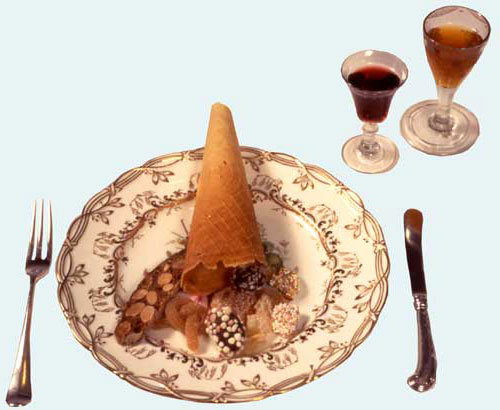
Wafer cornet, or cone, with diablotins, an early chocolate covered with nonpareil comfits,
apricot knots, and spice biscuits with almonds
Although in modern times we associate wafer cornets with ice cream, they were probably originally served with the other sweetmeats during the dessert course. Since cannelons were filled with all sorts of fruit pastes and creams, it is probable that the very similar wafers were used in the same way.
In the late eighteenth century English setting to the left, these 'funnels' or 'cornucopias' are served with diablotins (an early chocolate sweet covered in comfits), apricot knots and spice biscuits (with almonds). See Regency Biscuits for a recipe for the spice biscuits.
Wafer cones are first mentioned in Bernard Claremont's The Professed Cook (London: 1769) and in Mary Smith's The Complete Housekeeper & Cook (Newcastle: 1770). Robin Weir has recently found some evidence to suggest that wafer cones were used for serving ice cream in France in the early nineteenth century. The earliest English record of this usage is in Charles Elmé Francatelli's The Modern Cook (London: 1846), in which he recommends cornets filled with ice cream as garnishes for a number of ice cream puddings, including the Iced Pudding à la Chesterfield. The popular theories that the ice cream cone was invented by Italo Marchiony in New York in 1896, or at the 1904 St. Louis World's Fair are entirely erroneous.
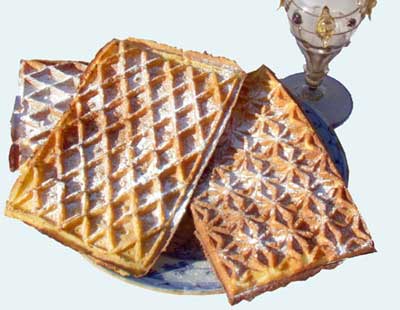
Dutch and Flemish style wafers
Flemish and Dutch wafers
Flemish and Dutch wafers, leavened with yeast, what we would call waffles nowadays, were also popular in England in the early modern period. Those illustrated above were made from the following 1724 recipe.'Right', means true or authentic.
The Right Dutch-Wafer
Take four Eggs, and beat them very well, then take a good Spoonful of a Pint of fine Sugar, one nutmeg grated, Cream, and a Pound of Flower, a Pound of butter melted, two or three Spoonfuls of Rose-water, and two good Spoonfuls of Yeast; mix all, well together, and bake them in your Wafer-tongs on the Fire. For the Sauce, take grated Cinnamon, Sack, and melted Butter, sweeten'd to your Taste.
From Mary Kettilby, A Collection of Above Three Hundred Receipts (London: 1724).
Cooks and confectioners from Mary Kettilby's era would have used a charcoal stewing stove or chaffing dish to make wafers.
