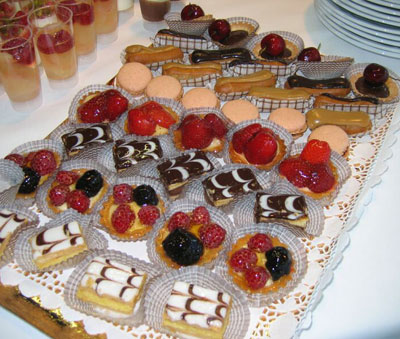
 French Desserts
The word "dessert" comes from the French word "desservir" which means "to clear the table." The word was first used during the 17th century to describe the offering of sweets (usually fruit or cheese) after the main course. The French perfected the craft of dessert making during the 17th and 18th centuries. Antonin Carême, considered the first "celebrity chef," created elaborate dessert sculptures for royalty. Over time, the custom of eating dessert became more popular. The French developed a multitude of delightful pastries, cakes and confections that are still celebrated today.
French desserts are typically made from cream, custards and fruit. Often delicate and complex in nature, they take time to prepare. Popular French desserts include chocolate mousse, crème brulee and flaky Choux pastries such as profiteroles, éclairs and cruellers. Other specialties include tarts, cake-like cookie madeleines and crepes with sweet fillings.
Here is an introduction to sweets served in France.
See also French Pastries.
Creams
A number of different creams serve as the basis for making other desserts. These include crème anglaise (a sort of custard sauce), frangipane (an almond flavored cream), crème pâtissière (pastry cream), and crème au beurre (a butter cream frosting).
Crème Anglaise - This translates literally as English cream. It is made by heating milk, adding it to beaten eggs, and than reheating the whole mixture until it thickens. It is frequently flavored with vanilla although other flavorings are possible. The result is a a fairly liquid dessert cream that is served cold, usually as an accompaniment to other things. A classic use of crème anglaise is in the confection of Ile Flottante (Floating Island) where you'll find islands of meringue floating on crème anglaise.
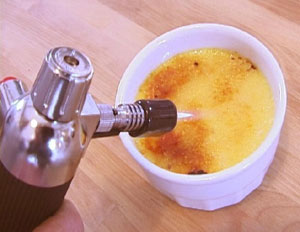
Crème Brûlée - Arguably the most delicious of all French desserts, crème brûlée is a symphony of contrasts. The cold, smooth, sweet crème, which is similar to a custard, sits under a crackling, hot, almost bitter caramelized topping.
Crème Caramel - The crème portion of this desert is very similar to a crème brûlée. Here, however, the caramel is cold and liquid. If the caramel is on top of the custard, it is also known as a crème renversée.
Crème Pâtissière - This translates as pastry cream. You will find it used in all sorts of fashions in French desserts: as a layer in a cake, on the bottom of a fruit tart, or as the filling in puff pastry. Crème âtissière is made in a fashion similar to crème anglaise, but flour or corn starch is added to the crème, so the result is considerably stiffer. This is basically what we call custard in English.
Creme d'Amandes - This is made from butter, powdered almonds, sugar, eggs and flour. It can be flavored with rum. It is used as a filling in various French desserts, notably a Pithiviers, which is a puff pastry pie.
Crème Frangipane - This is a mixture of crème d'amandes and crème pâtissière. It is used to fill various cakes and tarts, most famously the Galette des Rois, which is a cake eaten on and around Epiphany in France. Note the distinction between a pithiviers and a galette des rois.
Crème Fraiche - This is considerably different from the other crèmes I have mentioned, as it is a specific milk product used as an ingredient in many French desserts as well as other French recipes. Crème fraiche is obtained by skimming off the cream that naturally forms on the top of milk. It has a wonderful feel in the mouth and a taste that you might describe as nutty.
Crème Glacée - You know this as ice cream. The French make the distinction between glace, which is ice cream made from milk, and crème glacée which is ice cream made from cream.
Sauces
This is France, so of course sauces play a part in dessert as well. Various fruit coulis are made by cooking fruit in sugar syrup and then pureeing the mixture.
Ganache
Chocolate and whipping cream are mixed together to make a chocolate ganache, used to frost or fill cakes. A ganache might be made with different sorts of chocolate and flavors.
Entremets
Any dessert that isn't a cake or pastry might be referred to as an entremets in France. The term is particularly associated with cold desserts such as flans, charlottes, or puddings.
Bavarois (Bavarian cream desserts)
Molded cold desserts that might include whipped cream, crème anglaise, fruit puree, meringue, chocolate or liqueur. They are set with gelatine. The base for bavarois is crème anglaise, which is thickened by adding egg yolks, sugar, vanilla, and cream or milk. The dessert is carefully cooked in a water bath before mixing in gelatine or isinglass to further thicken the mixture. Whipped cream is then folded in to add a special lightness to the dish. Known as a Bavarian cream in English.
Charlottes - Lady fingers are used to line a special mold which is then filled with a Bavarian cream, mousse, or fruits.
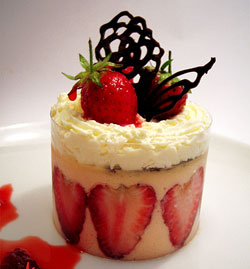
Strawberry Bavarois is a dessert that was introduced by the French people during the 19th Century. Not everybody had money for cream or other dairy products, so this item was a real luxurious dessert. Nowadays, cream is much more affordable and strawberries still very popular. |
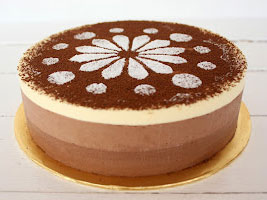
The one and only mousse cake for the true chocolate lover. What’s more heavenly than the combination of dark chocolate, milk chocolate and white chocolate in one cake? Two layers of chocolate sponge and three layers of airy mousse yields the most luscious way to please crowds! |
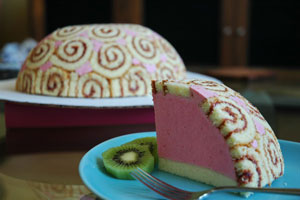
Charlotte Royale is a spectacular cake that is two desserts in one. An outer shell of Swiss cake rolls hide a beautifully creamy filling studded with strawberries. It’s fancy enough for even the most special birthday, but the light texture makes it a great everyday dessert option. There is also a Chocolate Raspberry Charlotte Royale version. |
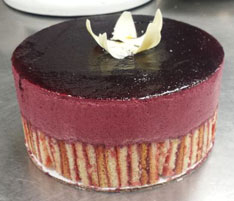
Fruit Mousse Miroir - biscuit joconde (light almond sponge cake), raspberry jam, genoise, mousse aux fruits. The art of patisserie decoration has been handed down from chefs to apprentices for generations. The Miroir range of glazes is an integral part of this heritage. Miroir allows you to quickly create an incredibly shiny and glossy finish for your mousse cakes. |
Frozen Desserts
In addition to ice cream and sorbets, there are more elaborate presentations such as a bombe, a layered and molded dessert that makes a spectacular presentation.
Cakes
Although frequently made with the same basic preparations, the variety of gâteaux in France is nearly infinite. Note that the French word cake refers to unfrosted bread like cakes that might include fruit or nuts. Banana bread, for example, would be cake aux bananes.
Almond Sponge Cake (Biscuit Joconde) - may be stacked, layered with jam, and sliced to decorate the outside of a cake (for instance, Miroir aux Fruits), or it may be made into a roll, filled with jelly, and used to decorate a Charlotte Royale. It can also be used as a component in layered cakes and petits fours such as Opera Cake.
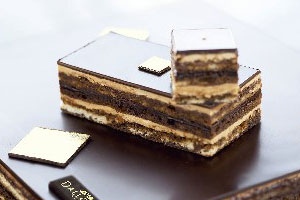
Opera cake (French: Gâteau opéra) is a French cake made with layers of almond sponge cake (known as Joconde in French) soaked in coffee syrup, layered with ganache and coffee (or Grand Marnier), French buttercream, and covered in a chocolate glaze. |
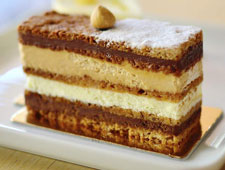
Both crispy and creamy in texture, this French cake is traditionally made with almond or hazelnut meringue sponge cake separated with layers of whipped cream or buttercream. The cake takes its name from the French word dacquois, meaning from Dax, referring to a town located in southwestern France, but the term dacquoise itself has come to signify any dessert with layers of nut meringue sponge cake. |
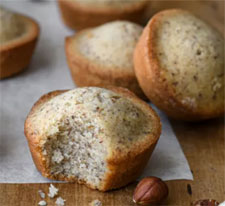
Classic French bite-sized cakes made with roasted nuts and brown butter. They’re extremely versatile: you can make them with any type of nut and garnish them with any fresh or roasted fruits, dried fruits, citrus zest, nuts or even chocolate chips. Financiers (small cakes) |
Petits Fours
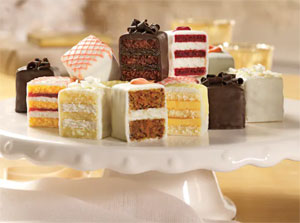
A petit four is a fancy French dessert that is essentially a mini pastry. This type of pasty is typically served with coffee, tea or wine and is an elegant treat that can even be served at a wedding. They are elaborated to please the eye as well as the palate.
Petits fours glaces is the most common type of petit four that you will find within the United States. These small pastries are made from sponge cake or pound cake with layers of chocolate, fruit or buttercream in the center. These cakes are then cut into small shapes such as squares, rectangles, circles, hearts or diamonds. The shapes are glazed with a pourable fondant, icing or ganache glaze.
Petits fours secs are created with cookies rather than cake. The traditional type of cookie used is shortbread, which is a crisp, buttery cookie. Petits fours secs can also be created using butter or sugar cookies. A filling is added between two cookies. Fillings include fruit preserves, chocolate or a nut paste such as almond or praline. Petits fours secs can be left as is or glazed with ganache, fondant or icing.
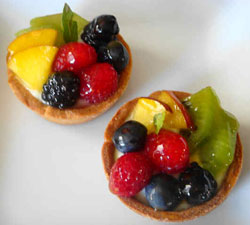
Petits fours frais are created with mini pastries. The most common types of mini pastries are fruit tarts, éclairs or cream puffs. Cream puffs and éclairs are typically filled with buttercream or pastry cream, while fruit tarts are made with custard and then topped with fresh fruits. Some petits fours frais are also made with marzipan and look like truffles. Petits fours frais are not typically glazed, but some éclairs and cream puffs will have a chocolate glaze placed on top to finish them off.
Choux Pastry
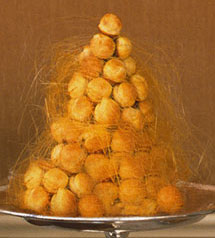
An airy pastry used to make profiteroles, eclairs and any number of elaborate French desserts. Croquembouche, a cake often served at weddings, is a high cone of profiteroles (choux filled with pastry cream) sometimes dipped in chocolate bound with caramel, and usually decorated with threads of caramel, sugared almonds, chocolate, marzipan flowers, or ribbons.
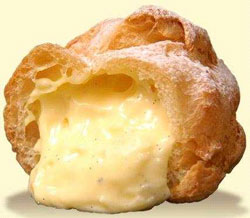
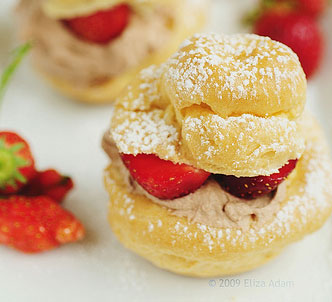
A profiterole (French), cream puff (US), or chou à la crème (French) is a filled French choux pastry ball with a typically sweet and moist filling of whipped cream, custard, pastry cream, or ice cream. The puffs may be decorated or left plain or garnished with chocolate sauce, caramel, or a dusting of powdered sugar. Cream Puffs (Profiteroles) |
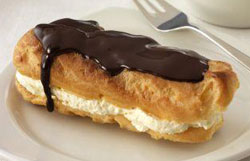
An éclair is a pastry made with choux dough filled with a cream and topped with a flavored icing. The dough, which is the same as that used for profiterole, is typically piped into an oblong shape with a pastry bag and baked until it is crisp and hollow inside. Once cool, the pastry is filled with custard (crème pâtissière), whipped cream or chiboust cream, then iced with fondant icing. Other fillings include pistachio- and rum-flavoured custard, fruit-flavoured fillings, or chestnut purée. |
|
|
Recipes
Cream Puff Dough (pâte à choux)
Cream Puffs w/ Lemon Mousse & Blueberry sauce
Beignets
Fried dough that sometimes encases a fruit or flower. You'll find different traditional versions of the beignet all over France. Similar to American doughnuts, however, beignets tend to be very light and airy and are often hollow in the center. French beignets are different from the French Quarter-style beignets that are so familiar in New Orleans. Instead, it is made with choux pastry dough, which is the dough used in cream puffs and éclairs. Made using only butter, water, flour, and eggs, the moisture in the dough allows it to rise without the need for yeast.
As with most culinary traditions in France and elsewhere, Mardi Gras beignets have regional variations, giving you ample reason to try a different city every year. Basic dough recipes can be different, as are resulting names: from bugnes near Lyon to roussettes in Chartres, and more. For those who enjoy a beignet with a denser, chewier texture that’s still light as air, there’s a variation you can’t miss. Pets de nonne, literally “nun’s farts” (really), are fluffy clouds of deep-fried choux pastry dough.
Because only having a dozen variations on the Mardi Gras beignet would be too easy, France also associates beignets with a beloved after-school snack. Step into a bakery that, hopefully, bakes its own beignets, and you’ll see something resembling a jam or Nutella-filled doughnut. This is a denser snack than the traditional Mardi Gras beignet, and one is usually enough.
Viennoiseries (French for 'Viennese specialties')
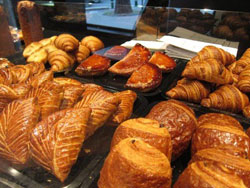
Viennoiseries are baked goods made from a yeast leavened dough in a manner similar to bread, or from puff pastry, but with added ingredients (particularly eggs, butter, milk, cream and sugar) giving them a richer and/or sweeter character, approaching that of pastry. The dough is often laminated.
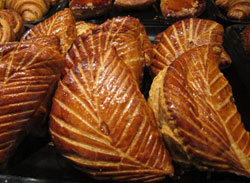
Viennoiseries are typically eaten at breakfast or as snacks. Examples include croissants, Vienna bread and its French version the baguette viennoise, brioches, pain au chocolat, pain au lait, pain aux raisins, chouquettes, Danish pastries, bugnes, and chausson aux pommes. The popularity of Viennese-style baked goods in France began with the Viennese Bakery opened by August Zang in 1839.
|
|
Crêpes
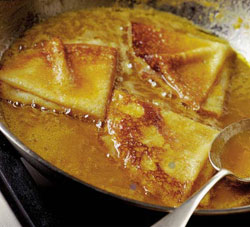
Often served as part of a traditional celebration, in particular for Chandeleur, the French version of Candlemas. Crêpes Suzette, made with a hot sauce of caramelized sugar, orange juice, grated orange peel and liqueur (usually Grand Marnier) on top, which is flambéed, is perhaps the most famous, but there are many other crepe preparations.
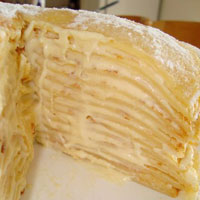
Mille Feuille Crêpe Cake is make by layering crêpes with a vanilla pastry cream that has been folded with a Kirsch flavored whipped cream. The top of the cake is dusted with confectioner's sugar. |
|
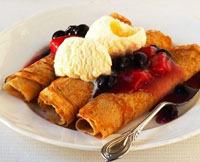
Crêpes flavored with oranges and Grand Marnier, usually served with vanilla ice cream
|
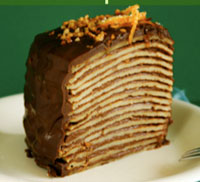
Chocolate Crêpe Cake is made with layers of chocolate crêpes. |
Recipes
Crêpes - basic crêpes recipe
Caramel Apple Crepes - Crêpes topped with a caramel sauce made with brown sugar and cream, sauteed sliced apples and toasted walnuts.
Diplomates
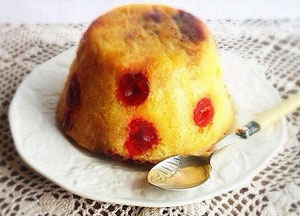
Brioche bread soaked in milk or perhaps rum, is layered in a mold with different fruits and then cooked in a bain-marie. The dessert is then served cold. Many versions of this French dessert exist.
The precise origin of the name diplomate is unclear, but this pudding, which is classically made with brioche or sponge cake, dried fruit and custard and served cold, is also referred to as cabinet pudding and chancelière.
Egg Based Desserts
Other than sweet souffles, these include such classics as crème caramel, crème brûlée, petits pots, and oeufs à la neige.
Crème Brûlée is an egg and cream custard topped by a delicate layer of caramelized sugar. |
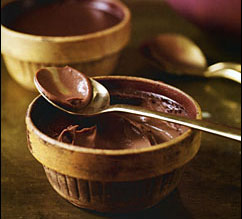
Chocolate Pots De Crème is a light, yet rich, creamy chocolate custard baked in the oven in a water bath, then chilled before serving. |
Recipes
Crème Caramel
Flans
Flan is a baked custard quite similar to crème caramel. It is typically made with eggs, cream or milk, gelatin and vanilla. French flans are often made with a pastry crust base and might include various fruits, as in Far Breton.
Cherry Clafoutis, pronounced cla-foo-tee, this classic French dessert is incredibly easy to make and nothing short of delicious. The clafoutis originated during the 19th century in Paris and quickly became popularized around France. It’s essentially a fresh cherry flan that is most frequently served and eaten warm. Recipe for Cherry Clafouti
Mousses
Frequently made with beaten egg whites, but also whipped cream, and even thickened with gelatine, these are light airy preparations that might be enjoyed on their own or used to fill another dessert.
Puddings
In France, a pudding normally includes bread or cookie crumbs, but also rice and semoule wheat.
Riz au Lait is a very traditional dessert, and often eaten for breakfast, but not one that you will find in restaurants or bakeries. Riz au lait is usually homemade, as it is cheap and easy to prepare. It’s plain white rice slowly cooked with sugar and milk until the texture thickens. That’s it! Ironically, in the recipe’s early days (14th to 16th centuries), this dessert was actually reserved for nobles and aristocrats as it was seasoned with saffron, a very rare and pricey spice. Nowadays, people add cinnamon powder and raisins to the mixture, or sometimes caramel sauce.
Tarts
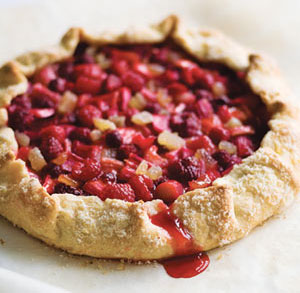
Includes fruit and nut tarts of all sorts. The base might be puff pastry or short bread.
|
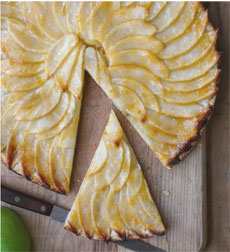
This Tarte Fine aux Pommes – literally “Thin Apple Tart” – is a French bakery staple in the Fall. It features a thin puff-pastry crust with no raised borders, thin apple slices for topping and crisp caramelized edges. I love how it’s quickly put together, requires no tart pan, yet makes for an utterly delicious and elegant dessert. It’s light, flaky and best enjoyed by hand. |
Rhubarb Tart is most popular in the Lorraine region of France, near Germany. As the temperature and soil type seem to aid the growth of rhubarb. |
Fruit Desserts
As well as serving as an ingredient in other French desserts, fruit may take the center stage. They might be flambéd, poached, baked, or made into compotes (stewed fruits).
Cookies
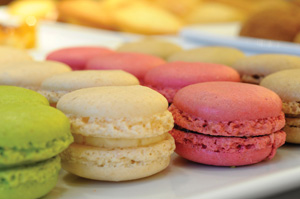
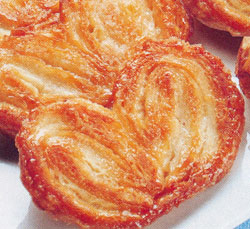
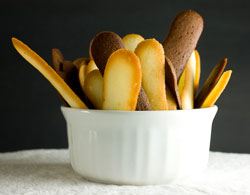
In The French Cookie Book, by Bruce Healy you learn that there are seven basic types of French cookies. These are creamed sugar and butter, meringue, almond paste, sponge cake, tuiles, pate sucree (sweet pastry), and puff pastry. Macarons, sablés, speculoos, langues de chat, madeleines, tuiles, and palmiers are just a few of the cookies popular in France.
Meringues are airy delights made of egg whites and sugar, baked at a low temperature until crisp. Some modern versions add mini chocolate chips or other flavor accents. According to Larousse Gastronomique, meringue was invented by a Swiss pastry chef named Gasparini, who lived in the small German town of Meiringen. Until the early 19th century, meringues cooked in the oven were shaped with a spoon. It was the great French chef Antoine Carême (1784– 1833) who first had the idea of piping meringue through a pastry bag.
|
|
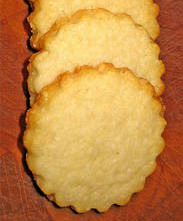
Pronunciation: [SAH-blay] This classic French butter cookie is said to hail from Caen, in the province of Normandy. The French word sablé means "sand," and the cookies are so named because of their delicate, crumbly texture. Sablés can be variously flavored with additions such as almonds or lemon or orange zest. They can also be dipped in chocolate or two cookies may be sandwiched together with jam. |
|
Candy
The French eat something sweet after dinner at home and in restaurants. It can be simple, like yogurt and fruit sprinkled with sugar. It’s often chocolate.
Notable French candies include berlingots, salted caramels, nougat, calissons, and dragées, but there are many more. A fun part about French candy are the stories that frequently accompany them.
Rochers (chocolate covered fruits & nuts)
Mendiants (chocolates w/ nuts & fruits)
Chocolate Truffles
