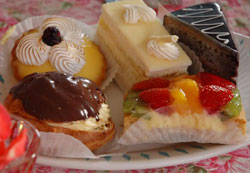
French Pastries
Here is a list of the most commonly found pastries at patisseries across France. The list is comprehensive, but not exhaustive, as the French have about as many types of pastries as the Eskimos have for the word snow.
Also see French Desserts.
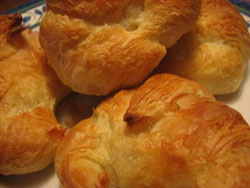
Croissant
The old standard, you can never go wrong with this crescent shaped, buttery and flaky pastry. The perfect balance of sweetness and puffiness, crispiness and softness, a well made croissant will melt in your mouth and have you craving another as soon as you finish the first. The original French pastry, it is rumored the croissant first appeared in French cuisine after the Muslim defeat by the French at the Battle of Tours in 732. The pastry was given its shape to represent the Islamic crescent.
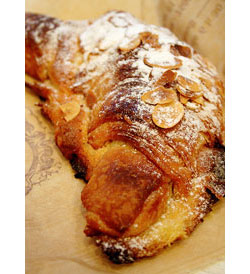
Croissant Amande
Almond croissants are not simply croissants topped with almonds and powdered sugar. This delightful treat is also filled with almond paste (which is made from sugar, almond mill and butter and/or cooking oil). The result is a crispy, nutty, yet soft in the middle treat that will make you swoon. Well made croissants amandes will make you quickly slip into a dream-like state.
French Almond Croissants (Bakery Style)
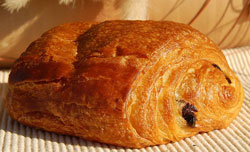
Pain au Chocolat
Cousin to the croissant, a pain au chocolat is basically a croissant-type puff pastry containing strips of chocolate (usually dark chocolate). Literally translated as “chocolate bread,” pains aux chocolates are a favorite in France and are best when served hot with the chocolate melting into the pastry in the middle. Just imagine the chocolate oozing from the buttery, flaky pastry.
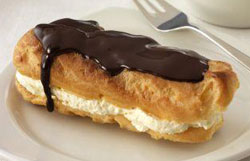
Chocolate Éclair
Another French favorite, éclairs are long, thin pastries made from choux pastry (which literally translates as “cabbage” pastry because of its appearance when made) and are filled with cream and topped with icing (usually chocolate). In France, éclairs are made by baking the oblong choux until crisp and hollow and then filling it with coffee or chocolate flavored pastry cream. Other favorite fillings are custard or freshly whipped cream, rum-flavored custard, almond or chestnut puree or fruit fillings. Éclairs will vary from patisserie to patisserie, but are almost always delicious.
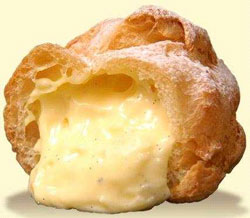
Cream Puff
Profiteroles (aka a Cream Puffs): These delightful little treats are made with choux pastry that is baked into small round puffs, which when cooled become hollow in the middle, and are served with whipped cream or custard in the center. You will commonly see them garnished with a hardened caramel sauce. Stacked profiteroles called croquenbouche are often served at weddings in France.
*+Cream Puff Dough (pâte à choux)
*Cream Puffs (Profiteroles w/ whipped cream filling)
Cream Puffs filled w/ Ice Cream
Cream Puffs w/ Lemon Mousse & Blueberry sauce
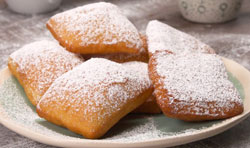
Beignet
The French version of a doughnut, beignets are a deep-fried pastry often served garnished with powdered sugar. In France, beignet is an umbrella term for a variety of different pastries that can be either sweet or savory. In fact, you will sometimes find beignets filled with potatoes, mushroom or meat. Unlike American doughnuts, however, beignets tend to be very light and airy and are often hollow in the center. They are best when served hot.
Recipe for Beignets (made with yeast)
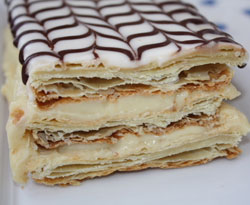
Traditional Napoleon
Mille-feuille (also called Napoleons): This pastry’s name literally translates as “thousand sheets,” and is a pastry made from several layers of puff pastry alternating with a sweet filling (usually pastry cream, whipped cream or custard). Traditionally, a Mille-feuille is made up of three layers of puff pastry, and two layers of crème pâtissière; the top is glazed with icing, in alternating white (vanilla icing) and brown (chocolate) strips, and then combed. Every patisserie in France will have its own version of this pastry, including differently flavored creams, such as strawberry, and topped with different icings.
Classic French Napoleon (Mille-Feuille)
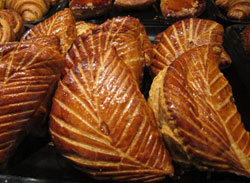
Chausson aux Pommes (apple filled)
Chausson aux Pommes is a classic pastry and is usually found at almost any patisserie across France. It is made with a puff pastry crust much like a croissant and filled with chunky, apple-sauce like filling. They are best when served warm and there is just something so delicious about the flaky pastry against the soft, gooey apple filling that makes these an all-time favorite treat.
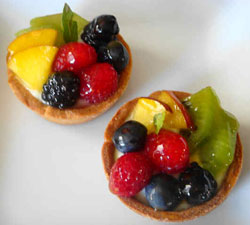
Tarte
The French answer to American pies, you will find a huge variety of tartes in all shapes and size with all kinds of fillings. They are usually made with a thin, flat layer of pastry and then are topped with fruit. You will sometimes see a layer of custard in between the pastry and the fruit, but French tartes are always open faced. A favorite is apple tart, which usually manages to have the finest slices of apples layer over the pastry.
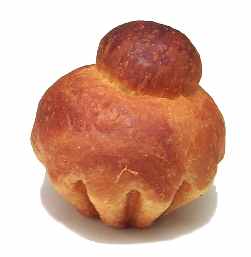
Brioche
Although more of a bread than a pastry, because of its sometimes sweet flavor, brioche makes it on this list. Brioche is a bread made with high butter and egg content, which gives it a sweet, rich flavor and tender consistency. It is often topped with an egg wash before baking, giving it a flaky, deep golden crust. A brioche a tete, which translates as “brioche with head” adds a small roll of the dough on top and are baked in muffin-like tins to achieve their small, rounded shape.
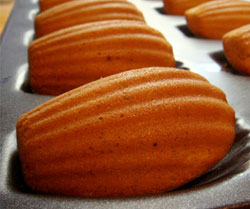
Madeleines
These little cakes have a distinctive shell-like shape and have the consistency of a very light pound cake. They often also have a pronounced butter and lemon taste and are often made with almonds as well. You will find these little cake-like cookies across France and they are a favorite treat among children.
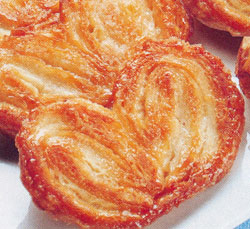
Palmiers
Palmiers are crispy and delicate leaf-shaped cookies made from puff pastry. They are made by rolling out pastry dough, sprinkling it with sugar and then folding it several times. The two sides of the pastry are then rolled inwards to meet at the center and the cookie is baked until crispy and caramelized. These are the perfect balance of crispy and flaky and always seem to be just sweet enough.
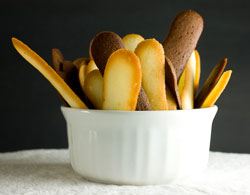
Langues de Chat
This simple, yet delicious cookie which translates literally as “Cat’s tongues” is standard treat of childhood. They are a simple cookie made from butter, sugar, flour and eggs and have a light yet crispy texture. They get their name for their long, tongue-like shape. They are a classic French cookie. Variations, such as Chocolate Langues de Chat, are often found.
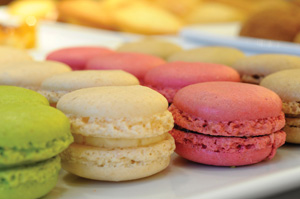
Macarons
These delightful little cookies from northeastern France are not much like their American cousin the Macaroon, which are dense cookies made with coconut. The cookie is made from egg whites, almond powder and icing sugar. They are sandwich-like pastries made with two thin cookies with a thin layer of flavored icing in the center. Macarons are delicately crunchy on the outside and are moist, chewy and flavorful on the inside. They are very light and come in every flavor under the sun. If you find yourself in Paris, you should not resist the temptation to get a bag of macarons where they were first invented at the Ladurée pastry shop on the Champs Elysées, where 15,000 of these delightful little cookies are sold each day.
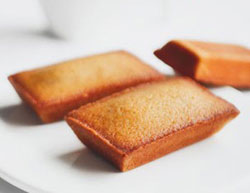
Financiers
Financiers are rich, tiny cakes made with almond flour, brown butter, and egg whites. Usually baked in small molds, financiers are traditionally rectangular in shape, but they’re also often made in round molds, such as the ones in a mini-muffin pan. The perfect financier will have a springy texture, golden and crispy edges, while the center will remain moist and tender.
They’re extremely versatile: you can make them with any type of nut and garnish them with any fresh or roasted fruits, dried fruits, citrus zest, nuts, or even chocolate chips.
Financiers (small cakes & variations)
Roasted Hazelnut Financiers
Coconut Financiers
