Fresh, Unripened Cheeses
The main factor in the categorization of these cheeses is their age. Soft fresh cheese is cheese in its youngest, purest form. They are milky and moist, created to be eaten not long after they are made. The differences among them are like shades of white to an interior designer, subtle but distinct; some versions work better in certain applications than others. These are cheeses which do not undergo a maturing process. In taste they are the mildest and retain much of the fresh milk flavor. They are usually not salted. Because these cheeses are fresh, you must store them in the refrigerator. Each is freshness dated, like milk.
Variations come with the strains of bacteria a cheese maker selects, along with fat content, pasteurization, salt and time. But the process is basically the same: Milk is fermented by lactic acid bacteria or curdled by heat or acid from a souring agent like lemon juice or vinegar. Sometimes rennet is added to speed up the process.
Fresh cheese does not have a rind and is not aged for a significant amount of time. The texture ranges from creamy and spreadable, to soft and pliable, to crumbly. During the cheesemaking process, the milk for fresh cheese is "ripened" by adding starter cultures, which convert the milk sugar (lactose) into lactic acid. This encourages the milk to thicken. For denser, thicker, full-fledged curds, rennet is then added to thicken the milk even more. Once curds form, the liquid (whey) is drained away and what remains is turned into cheese.
To make fresh cheese like ricotta or goat cheese at home, ingredients such as lemon juice, vinegar or buttermilk can be used instead of starter culture and/or rennet as a short-cut method for ripening milk. For some types of fresh dairy products, like creme fraiche, the milk or cream can be thickened simply by leaving it out on a warm counter (if it's unpasteurized) or by adding buttermilk or yogurt with live cultures.
For these simplest cheeses, milk is curdled and drained, with little other processing. Examples include cottage cheese, Romanian Caş, Neufchâtel (the model for American-style cream cheese), and fresh goat's milk chèvre. Such cheeses are soft and spreadable, with a mild taste. The only strictly required step in making any sort of cheese is separating the milk into solid curds and liquid whey. Usually this is done by acidifying (souring) the milk and adding rennet. The acidification is accomplished directly by the addition of an acid like vinegar in a few cases (paneer, queso fresco), but usually starter bacteria are employed instead.
Whey cheeses are fresh cheeses made from the whey discarded while producing other cheeses. Provencal Brousse, Corsican Brocciu, Italian Ricotta, Romanian Urda, Greek Mizithra, and Norwegian Geitost are examples. Brocciu is mostly eaten fresh, and is as such a major ingredient in Corsican cuisine, but it can be aged too.
Traditional pasta filata cheeses such as Mozzarella also fall into the fresh cheese category. Fresh curds are stretched and kneaded in hot water to form a ball of Mozzarella, which in southern Italy is usually eaten within a few hours of being made. Stored in brine, it can be shipped, and is known worldwide for its use on pizzas. Other firm fresh cheeses include paneer and queso fresco.
Acid-set cheeses, including halloumi, paneer, some whey cheeses and many varieties of fresh goat cheese, have a protein structure that remains intact at high temperatures. When cooked, these cheeses just get firmer as water evaporates.
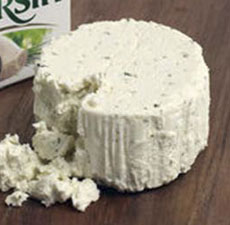
Boursin
Boursin is a trademarked brand of Gournay cheese. It is a soft creamy cheese available in a variety of flavours, with a flavour and texture somewhat similar to cream cheese.
The world's first variety of Boursin, was created in 1957 in Normandy by Francois Boursin. Inspired by a long-standing traditional dish, fromage frais (fresh cheese), in which guests mixed their own seasoned cheese from a bowl of fine herbs, the expert cheese maker introduced Boursin Garlic & Fine Herbs. His recipe quickly became the first flavored fresh cheese to be sold throughout France.
Boursin cheese was first developed in Normandy, and at one time was produced exclusively in Croisy-sur-Eure, France, by the Boursin company. In 1990, the Boursin name was acquired by Unilever who sold it to Groupe Bel in November 2007 for 400 million euros. The cheese is still produced in the United States for North American distribution by Unilever.
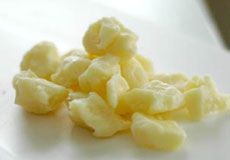
Cheese Curd
Cheese curds are the fresh young curds of cheese, often cheddar. They are generally available in retail stores operated at cheese factories throughout the countries of Canada and the United States (especially in USA's Upstate New York, Wisconsin, Michigan, and Canada's provinces of Ontario, and Quebec, where they can be found in many grocery stores.) Cheese curds are little-known in locations without cheese factories, because they should ideally be eaten within hours of manufacture.
Their flavor is mild with about the same firmness as cheese, but has a springy or rubbery texture. Fresh curds squeak against the teeth when bitten into, which some would say is their defining characteristic. They are eaten fresh or sometimes breaded and deep-fried.
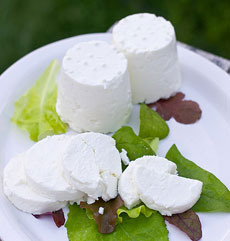
Chèvre (Fresh Goat Cheese)
Chèvre (French for 'goat') is cheese made from goat milk. Chèvre cheese, in soft forms, has a sharper taste than does cream cheese. It may be paired with herbs, covered in black pepper, and comes in a variety of sizes and shapes. The cheese is easily molded into small rounds, log shapes, or large rounds that are sliced.
Goat cheese has been made for thousands of years, and was probably one of the earliest made dairy products. In the most simple form, goat cheese is made by allowing raw milk to naturally curdle, and then draining and pressing the curds. Other techniques use an acid (such as vinegar or lemon juice) or rennet to coagulate the milk. Soft goat cheeses are made in kitchens all over the world, with cooks hanging bundles of cheesecloth filled with curds in the warm kitchen for several days to drain and cure. If the cheese is to be aged, it is often brined so it will form a rind, and then stored in a cool cheese cave for several months to cure.
Goat cheese softens when exposed to heat, although it does not melt in the same way many cow cheeses do. Firmer goat cheeses with rinds are sometimes baked in an oven to form a gooey, warm cheese, which is ideal for spreading on bread with roasted garlic, or alone.
It can merely be eaten on crackers or bread, or spread onto bagels for a delicious alternative to cream cheese. Chunks of soft chèvre are excellent in salads or make a great addition on a cheese and fruit plate.
Substitutions: mascarpone for fresh chèvre, feta for aged chevre
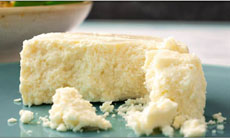
Cotija
Cotija is an aged Mexican cheese made from cow's milk and named after the town of Cotija, Michoacán. White in color and firm in texture, its flavor is salty and milky. "Young" (or fresher) cotija cheese has been described as akin to a mild feta, while aged (añejo) cotija is more comparable in flavor to hard, aged cheeses like Parmesan. Cotija softens when exposed to heat, but does not melt.
Made between the summer and fall seasons; this cheese is made with milk from local cattle and is salted before the fermentation process. It is a seasonal cheese produced in limited quantities only from July to October because the cows are fed only on the rich grass that grows naturally on the mountains during the rainy season, giving the cheese its unique color and flavor.
The manufacturing processes of most cheeses in Mexico are still rustic and traditional, similar to the manufacturing process that was used upon its invention. Due to the traditional means of production of dairy products in Mexico some dairy products have a conflicting shelf-life which leads to earlier expiration. However, some studies suggest components in the fermentation of Cotija Cheese is a natural preservative that can extend the shelf-life of Cotija Cheese and other food products as well.
The production method involves milling the curds into small pieces before pressing and aging. When cooked, it slightly softens, but does not otherwise change its shape or consistency. In the mouth, the cheese breaks up again to a sandy or grain-like consistency, adding to the texture of dishes.
Cotija is often used as a "finishing" cheese in Mexican cuisine, crumbled or grated as a topping for burritos, soups, salads, beans, tostadas, or tacos, and Mexican elote (corn on the cob). If cotija can't be found, acceptable substitutes for fresh cotija include feta or queso fresco. Acceptable substitutes for aged cotija include ricotta salata, Parmesan, or Romano cheese.
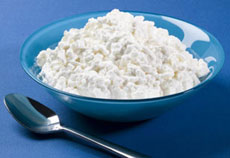
Cottage Cheese
This fresh cheese originated in Middle Europe where housewives made only enough for each family’s consumption. It is also known as “curds and whey” since the curds (the solid part of the cheese) and the whey (the liquid that's typically discarded during the process of making other cheeses) are not fully separated; by contrast, hard cheeses like cheddar and parmesan are made by pressing all of the whey out of the cheese.
This fresh cheese is made from whole, part-skimmed, or skimmed pasteurized cow's milk. Cottage Cheese is very mild, soft and moist with large or small moist curds that resist melting. The flavor will remind you of fresh milk with slight acidity, but nice and creamy.
A soft, creamy cheese, this starts with milk proteins that have been turned into curds and separated from the watery whey. The curds are washed to get rid of any remaining acid, so the cheese tastes mild or even slightly sweet. Curd size depends on the cheese maker’s style. A dressing made from cream or milk is mixed with the curd. Fat content, which can be as high as 4 percent, comes from the dressing.
If cottage cheese, which is very moist, is left to drain, "pot cheese" is formed. The name is a reference to a style of cheese easily made in a pot on top of a stove. It is sometimes sold as “dry-curd cottage cheese.” Draining longer still produces "farmer cheese." Works well for appetizers, fruit salads, cooking and snacks. Goes well with canned or fresh fruit, also tomatoes. Made in the United States.
Homemade Cottage Cheese
Making Cottage Cheese from Sour Milk
Substitutions: ricotta, yogurt cheese
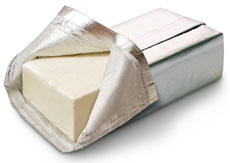
Cream Cheese
The earliest-known references to the style of cheese date back to the mid-1600s, in France. Cream cheese, a mildly tangy, creamy cow's milk cheese with the texture of butter, is made from a combination of cream and milk, and is not matured or hardened, as are other cheeses. Instead, it is slightly firmed by the introduction of lactic acid. Frequently, less expensive brands will add stabilizers like guar gum to get the necessary firmness, because the high fat content of the milk products is prone to separating. By law it must contain at least 33% butterfat and no more than 55% moisture.
Soft and spreadable, it is often used on sandwiches. Bagels topped with cream cheese is a classic use of the cheese. Recipes including cream cheese abound. These include the beloved cheesecake, cream cheese frosting, use of cream cheese in dips and spreads, and cream cheese added to omelets.
America’s most prominent brand got its name not because it was created in Philadelphia; it was first made in New York in 1872, by a dairyman named William Lawrence. In 1880, he adopted the brand name “Philadelphia” because that city was known at the time as a center of fine food.
Substitutes: Neufchatel or plain yogurt drained of moisture until the consistency of cream cheese (about 24 - 36 hours)
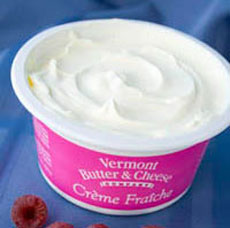
Crème Fraîche
Crème fraîche is cultured cream, a thickened cream with a slightly tangy, nutty flavor and velvety, creamy texture. The fresh cream is set aside to let the natural lactic bacteria take over. The bacteria thicken the cream to a consistency and richness almost like sour cream, though with a more delicate texture and tartness.
Crème fraîche does not separate or curdle when cooked with wine or at high temperatures, so is perfect for thickening sauces and soups, and imparting rich flavor and texture—it is a staple of French cuisine. The French make crème fraîche with unpasteurized cream; in the U.S., all fresh diary products (aged fewer than than 60 days) must be made with pasteurized milk or cream.
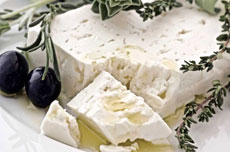
Feta Cheese
The making, or so-called pickling, of feta is an ancient practice. In Homer’s Odyssey, Polyphemus the Cyclops made sheep’s milk cheese, probably a forerunner of feta, which he ripened on racks in his cave. Considered the national cheese of Greece, feta is now made in many parts of the world. When stored in a liquid bath of brine, it will keep for months; otherwise it dries out quickly.
Feta is a Greek brined white cheese made from sheep's milk or from a mixture of sheep and goat's milk. It is soft, with small or no holes, a compact touch, few cuts, and no skin. Crumbly with a slightly grainy texture, it is formed into large blocks and aged in brine. Its flavor is tangy and salty, ranging from mild to sharp. Feta is used as a table cheese, in salads such as Greek salad, and in pastries, notably the phyllo-based Greek dishes spanakopita "spinach pie" and tyropita "cheese pie". It is often served with olive oil or olives, and sprinkled with aromatic herbs such as oregano. It can also be served cooked (often grilled), as part of a sandwich, in omelettes, and many other dishes.
On the whole, feta is a pickled curd cheese that has a salty and tangy taste enhanced by the brine solution. The texture depends on the age, which can be extremely creamy or crumbly dry. Upon maturation of 2 months, feta is sold in blocks submerged in the brine. If required, it can be washed under water to remove the extra saltiness.
Feta is a great cheese to always keep in your refrigerator because it rarely goes bad (and can be used as a quick appetizer, or put on so many dishes like pizza, pasta, and salads for more flavor). Keep the feta in its brine in a covered container and it stays fresh for weeks or even months. If the feta tastes too salty, rinse it with water before serving.
Homemade Feta Cheese (can be made with cow milk)
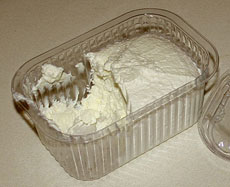
Farmer's Cheese (Baker's cheese)
Farmers cheese originated on farms throughout the world as a way to use milk left after skimming the cream for butter. Two main styles evolved – a fresh cheese similar to Cottage Cheese and a semi-soft version cured for a short time that is firm enough for cubing or shredding.
This mildly acidic fresh cheese is made by pressing much of the liquid (whey) out of cottage cheese. Very dry farmer cheese is available in solid loaves. It's primarily used for cooking.
Many countries have their own version of farmer's cheese: like the slightly spongy Mexican queso fresco (which can be salted or not) and Queso Blanco, or the Indian chenna, which is like more like dry cottage cheese, and Paneer, which is chenna that is pressed and easily cut into cubes. (Neither Indian cheese is salted.) Middle-Eastern countries have Haloumi. Almost all share a slightly sweet, milky flavor and a texture that is soft but somewhat rubbery. This texture holds up even under heat; most farmer's cheeses soften into a marshmallow-like texture but do not completely melt.
Essentially cottage cheese before it has been dressed, farmer’s cheese is sometimes hung in cheesecloth or pressed to make a crumbly but solid mass; the American style is salted. Different nations have different versions,
Nowadays Farmer’s cheese is made by heating milk and adding rennet to it. The rennet causes the milk to coagulate, forming large to medium-sized curds. The curds are then separated from the whey and pressed to remove any remaining liquid. The resulting cheese is mild, tangy and slightly crumbly in texture. The cheese can be made with cow, goat, or sheep’s milk, each produce different flavors and textures.
To make your own: Wrap cottage cheese in cheesecloth and place in a colander or strainer nested inside a bowl. Place in the refrigerator until much of the liquid has drained into the bowl.
Substitutes: queso fresco OR queso blanco OR jack OR Muenster
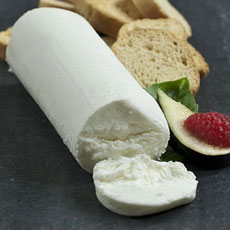
Fresh Goat Cheese (chèvre)
Goat cheese is any cheese made from the milk of goats. Popular throughout the world, and available in many forms, from soft to hard, it's one of the world's oldest cheeses, dating to the domestication of goats around 10,000 to 11,000 years ago. Goat cheese comes in many different flavors and textures - from crumbly to creamy, young to mature, mild to tangy.
“Chevre” means “goat” and is short for fromage de chèvre, or “cheese of goat” and is frequently used to refer to fresh goat cheeses in particular. Fresh chèvre is the most common type of chevre, often not aged for more than a few days, giving it the mildest flavor. It is a soft cheese that is very spreadable, and it is often sold and served in a log shape. This chèvre can be plain or mixed with fresh herbs.
Goat cheese has more fat than cow's milk cheese, and its flavor is tangier, since it is rich in caproic, caprylic, and capric acids—medium chain fatty acids that also help give goat cheese its unique, goaty aroma. Fresh, unaged cheeses such as chèvre, or those made from other animal milks such as mozzarella and feta, often have a bright white appearance. As cheeses age and lose moisture content, cheeses made from cow or sheep’s milk tend to take on a buttery, almost yellow hue. Goat’s milk cheeses, on the other hand, are easily spotted in a cheese board lineup because they tend to remain white in nature.
Goat cheese is made using a culture along with rennet. After warming the milk to around 65 F, a starter culture is added to begin fermenting the milk, followed by rennet, which begins the coagulation of the milk proteins, i.e. forming curds, a process take takes a day or two. This solid curd is then scooped into the various molds that will determine the shape of the cheese, whereupon it is drained for a period of around 24 hours. Salt is then sprinkled over the cheese, which, in addition to adding flavor, helps form the rind and controls the growth of microorganisms. Sometimes salt is added along with the milk.
Several fresh chèvres are made in a manner known as acid-set, where milk is allowed to ferment naturally, or with the addition of acid, to separate the curds from the whey, rather than with the addition of rennet, which is used in the majority of cheesemaking. While this may contribute somewhat to some goat cheeses’ especially tangy character, it is the nature of goat’s milk itself where its distinctive flavor arises.
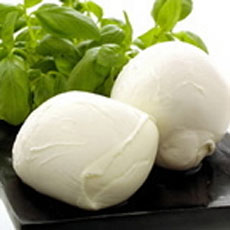
Fresh Mozzarella
This delicately flavored white cheese is semisoft in texture, creamy, smooth, and packed in water or a brine. It has a mild, milky flavor and a very creamy texture. Fresh curds are heated and stretched, then kneaded in hot water to form a ball of Mozzarella, which in southern Italy is usually eaten within a few hours of being made. Stored in brine, it can be shipped. A drier form is sold wrapped in plastic.
Mozzarella is a "pasta filata," a spun paste. Works best for pizza making and Italian casseroles and salads. Used on pizzas because of its excellent melting properties. Goes well with any Italian foods. Made in Italy.
In southern Italy where it originated, it is still made from water-buffalo's milk and is called mozzarella di bufala. Water buffalo’s milk is higher in both fat and protein than cow’s, yielding 1.6 times more cheese. It also lacks the yellow pigment, carotene, found in cow’s milk, so mozzarella di bufala is pure white. Almost all American-made mozzarella is from cow’s milk.
Substitutes: mild provolone, fontina
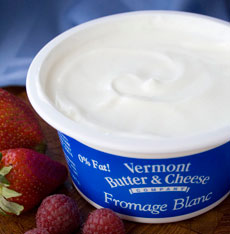
Fromage Blanc
Fromage blanc is a cow’s milk cheese related to quark. It is totally fat free and all protein. (Quark is not fat free). Many people eat it for dessert, either plain or with sugar and/or fruit. Fromage blanc is also used in uncooked savory dishes. Since it has no butterfat, it will separate if cooked.
While fromage blanc looks like yogurt, it is a proper cheese, beginning with rennet and a starter culture added to the milk. However, the curds are not allowed to coagulate as they would with a traditional cheese. Instead, they are stirred to the consistency of yogurt. Some producers add cream to achieve more richness, which can produce a product with up to 8% fat.
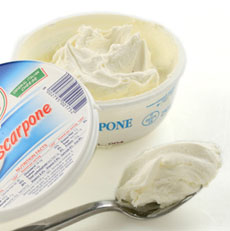
Mascarpone (mass-car-POHNE)
Sometimes called Italian cream cheese, mascarpone is a specialty of Lombardy, Italy. In fact, it is not cheese at all, but rather the result of a culture being added to the cream skimmed off the milk, used in the production of Parmesan. It’s smooth, rich, fatty and just the slightest bit sweet. Think of it as whipped cream without the air.
It is, however, described as a curd cheese, although it is made in much the same way as yogurt. To make Mascarporne cheese tartaric acid (natural vegetable acid derived from the seed of the tamarind tree) is added, the cream is gently heated, then allowed to mature and thicken. This whitish to straw-yellow, creamy, mild fresh cheese is compact, but supple and spreadable and it is added to famous Italian desserts, such as Tiramisu. It takes only a few days to ripen and has a fat content of 75 per cent.
Incorporated into recipes as an ingredient (tiramisu is one of the most famous), it also makes simple yet luscious desserts, served with fruit and biscuits like gingersnaps and strawberries, or as a topping for fresh berries, poached fruit or compote. Use it to stuff figs, dates or dried apricots (sprinkle with chopped pistachios), or fill tart shells and top the mascarpone with fresh or dried fruit. The name is said to date back to the 16th century, when a visiting Spanish dignitary tasted it and declared it “mas que bueno,” better than good.
Homemade Mascarpone
Homemade Mascarpone Substitutes
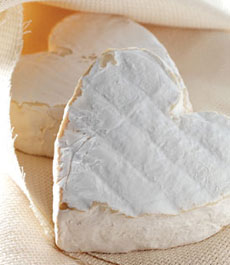
Neufchâtel (noof-sha-TEL)
French Neufchâtel is a soft, slightly crumbly, mould-ripened cheese made in the region of Normandy. One of the oldest cheeses in France, its production is believed to date back to the 6th Century. It looks somewhat similar to camembert, with a dry, white, edible rind, but the taste is saltier and sharper. It has the aroma and taste of mushrooms. Unlike other soft-white-rinded cheeses, Neufchatel has a grainy texture. It is usually sold in heart shapes, however it is also produced in other forms, such as logs. It is typically matured for 8–10 weeks. In 1872, a New York dairyman, in the township of Chester, created cream cheese as the result of an attempt to create a batch of Neufchâtel.
American Neufchâtel is a lower-fat cream cheese product marketed as a healthier alternative to cream cheese. American Neufchâtel is somewhat softer than cream cheese due to its 33% lower fat and higher moisture content.
Substitutes: cream cheese
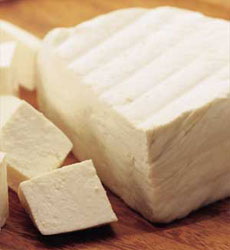
Panir (or Paneer)
Paneer is homemade cheese that is similar to pressed Ricotta cheese except the curd is drier and has no salt added. It is used in sweet and savory dishes.
All cheese starts off by the addition of a coagulant (curdling agent) to milk that has been brought to a boiling point. With many cheeses, an enzyme, rennet, is used to coagulate the milk proteins, but the whey proteins (albuminous proteins) don’t coagulate. They are drained, and can be used to make a whey cheese such as ricotta.
Paneer is made by adding an acid reagent to the milk (vinegar, lemon juice, yogurt, citric acid or cultured buttermilk) rather than rennet. When the milk curdles, both the milk proteins and the whey proteins coagulate. The whey is drained and the residue is pressed to obtain a soft but firm cheese with a creamy texture. Because no rennet is used, paneer is one of the primary protein sources among Buddists who adhere to strict vegetarian diets.
The cheese is usually pressed until firm, and, like ricotta, can be eaten fresh and raw. But unlike ricotta, panir holds its shape and can also be grilled, pan-fried, barbecued or deep-fried. Paneer is used in curried dishes and is very popular when wrapped in dough and fired. Paneer is often used in stir fry dishes because it does not melt. It is also used in preparation of popular desserts because of its delightful texture - and complete lack of salt - making it an ideal base for sweet recipes.
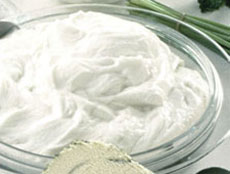
Quark
Quark (German word for curds) can best be described as a cross between yogurt and American curdless or small-curd cottage cheese.
Quark originated in Germany and/or western Austria and is similar to another fresh cheese, called “topfen” (pot cheese—and also is similar to ricotta). It may be made from cow’s goat’s, or sheep’s milk, or a mixture of two or more of those.
A white and unaged cheese, it is made by letting lactic acid bacteria (sometimes also rennet) ferment milk, which produces the resulting curd. Some or most of the whey is removed by hanging the cheese in cheesecloth and letting it drip off, to achieve the desired thickness. This gives handmade European quark its distinctive shape of a wedge with rounded edges; in commercial production it is formed into blocks.
In the United States and Canada, quark is a somewhat different product, often sold in plastic tubs with most or all of the whey. While American quark has the consistency of yogurt or sour cream, European quark is more like ricotta or pot cheese. Both styles are eaten with fruit like yogurt, but the European type is a common ingredient in European cheesecake and other pastries, soufflés and sauces. Quark is so popular in Germany that it accounts for almost half of Germany’s total cheese production.
Substitutes: yogurt cheese, mascarpone, strained cottage cheese
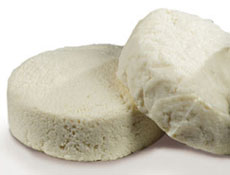
Queso Fresco on the left and
Queso Blanco on the right
Queso Fresco and Queso Blanco Fresco
Despite their similar names, flavors, and appearances, queso fresco and queso blanco are slightly different cheeses. To make queso fresco, producers use rennet and cultures to form the curds. Queso blanco requires just milk and an acidifying agent such as lemon juice or vinegar, making it an easy cheese to DIY at home. However, the two terms are often used interchangeably, and the cheeses are similar enough that you wouldn't likely notice a difference.
Queso fresco, one of the most commonly-used cheeses in Latin America. Queso fresco (fresh cheese) likely originated in Spain. It’s a soft, mild cheese made from curds. Cultures and rennet are added to pasteurized milk to create the curds, which are scooped into molds, then drained briefly. The resulting queso fresco is crumbly, with a mild and salty flavor and a slightly “grainy” texture. It is often sprinkled over foods, and when heated, it will melt. Queso fresco is most often used crumbled, as a topping for everything from salads to soups to enchiladas, and is melted in quesadillas and casseroles.
Queso fresco should not be confused with queso blanco fresco, although the latter is similar. Queso blanco fresco is a fresh cheese that is made by direct acidification (not cultures and rennet) and pressed into blocks. It consequently has a firm texture and softens but does not melt. Queso blanco can be eaten fresh, or it can be fried or grilled until crispy and golden brown on the outside and tender and squeaky inside.
Queso añejo is the aged version of queso fresco.
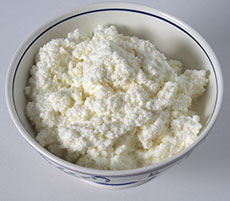
Ricotta
The lighter, fluffier, finer cousin of cottage cheese.
Actually not a cheese but a by-product of cheese-making. With many cheeses, an enzyme, rennet, is used to coagulate the milk, but the whey proteins (albuminous proteins) don’t coagulate. This milky-colored whey is drained and then heated a second time and curdled with vinegar; ricotta is produced from the curds that precipitate from those proteins. Ricotta means “re-cooked,” referring to the second heating of the milk.
Ricotta is a fresh "cheese" similar to cottage cheese, but slightly sweeter with a finer curd, and contains around 5% fat. Like many fresh cheeses, it is highly perishable and it should not be frozen. Ricotta is produced from whey when cheeses, such as mozzarella, are made. Like mascarpone in northern-Italian cuisine, ricotta is a favorite component of many Italian desserts, such as cheesecakes and cannoli. Made in Italy.
Ricotta Salata is a pressed ricotta which is made almost exactly as Farmer’s cheese (without the rennet).
Substitutes: cottage cheese
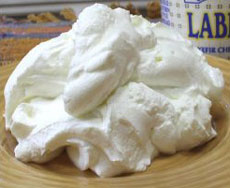
Yogurt Cheese - Labné
It is from Lebanon that we received the gift of labné, also known as kefir, the Lebanese version of cream cheese. In a nutshell, labné is a yogurt cheese, but it is often quite rich. The flavor is slightly tart and refreshing. In its country of origin, it is most commonly viewed as a staple of the breakfast table, but in the U.S. it is more often used as a dip for veggies and/or pita bread—although it spreads wonderfully on toast and bagels and its slight tartness is a delightful complement to jam.
As a dip with toasted pita, serve on a plate with a depression in the middle, filled with extra virgin olive oil, sprinkle with chopped fresh mint leaves or thyme, and surround with black Mediterranean olives. Or serve with chopped mint as a side to roast lamb. Popular throughout the Eastern Mediterranean and Middle East, there are Middle Eastern restaurants in which a good labné can be a highlight of the meal.
Substitutes: cream cheese
