Artisan Breads
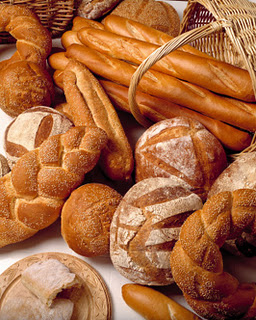
Artisan bread is exactly what its name suggests: bread that is crafted, rather than mass produced. Baked in small batches rather than on a vast assembly line, artisan bread differs from prepackaged supermarket loaves in a number of ways. Special attention to ingredients, process, and a return to the fundamentals of the age-old bread-making tradition set artisan bread apart from soft, preservative-laden commercial breads.
Whereas a store-bought loaf of mass-produced wheat bread might have nearly twenty ingredients, artisan bread will have closer to five. The basic building blocks of bread are flour, water, yeast, and salt. Sourdough is added for some breads; eggs and sugar for others.
For a more complex, flavored artisan bread, the ingredients list might expand to include various other items, all of them recognizable: sliced onions, cheddar cheese, sun-dried tomatoes, olive oil. Bread has been around for centuries. No chemicals were added to the breads baked by ancient Egyptians or those mentioned throughout the Bible, and none are added to artisan breads now.
The process of crafting and baking an artisan bread remains largely the same as then, too. Quality ingredients are mixed, slowly fermented, hand shaped, and baked in small batches in masonry ovens. Often, steam is utilized during the baking process to produce the crispy golden-brown crust characteristic of certain varieties of the artisan loaf.
Baking Artisan bread is a traditional one at that. It is one of the oldest forms of bread making around. For over 5,000 years, from man's first bread in Egypt to the 19th century, when commercially available baking powders and yeasts were available, all bread was leavened with starters.
Artisan breads' popularity is growing in culinary circles and are here to stay. Cultured yeast, which we now know as packaged yeast, was discovered in a French laboratory in the mid-1800s by Louis Pasteur then, and became commercially available at the end of that century. This sped up the process of bread-making, making it more appealing. However, there is now a resurgence. Bon Appetit lists Artisan bread baking as one of the top food trends, having already hit mainstream America. Ciabatta, a flavorful, crusty Italian peasant bread, or Sourdough Bread are often featured as an examples of breads that can be made at home.
There are two types of starters:
A sourdough starter is made from a batter (usually the consistency of mud) of wheat flour (grains) and approximately 85 degree F water called the "sourdough method". It is left out at room temperature to catch the wild yeasts and Lactobacillus, ferment and develop into a leavener for recipes. A sourdough takes days and months to develop; the very slowness of this natural leavening gives bread more depth of character and richness, such as a sour or wheaty taste, with a crusty crust and irregular air holes. When the starter is fully fermented, a piece of it is mixed with the bread's additional ingredients. This results in bread and other recipes with more flavor and an interesting texture. The remainder is replenished and maintained over time, sometimes for years, to again have a portion of it used in the next recipe, and so on.
A sponge starter (called a poolish) is made when a regular pancake-like batter from flour and water plus a leavener, being packaged yeast, an active sponge starter and/or a portion of a sourdough, called the "sponge method". In this case, the starter provides the flavor and the added yeast starts the fermentation and guarantees that the bread will rise quickly and reliably. Lactobacillus is not present in a sponge. Because of this, sponges do not produce the same results in terms of flavor, texture and keeping qualities as sourdoughs, and are often used in recipes where a lighter texture and milder flavor is desirable. A sponge's fermentation is measured in hours. When it ferments (gets bubbly and smells sour and yeasty), it can be used.
Examples of Artisan Breads:
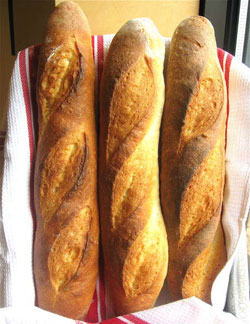
Baguette (baa-GHETT)
A long, thin loaf of French bread with a hard, crisp crust and an airy, chewy interior. It contains just flour, water, salt, and yeast from a starter.
It should be 18 to 30 inches long and weigh between 9 and 12 ounces. The crumb (inside) is open with lots of irregularly shaped air holes, the crust a rich golden brown color, with five to seven similarly sized overlapping cuts on the top of the loaf. The thin edge of the cut should stand a touch above the rest of the loaf.
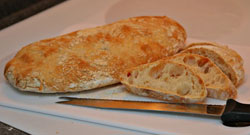
Ciabatta (chee-BAH-tah)
A rustic, oblong, flat bread whose name means "slipper" in Italian. Unlike focaccia (see below), its top is usually unadorned with herbs and oil. It usually made with flour, salt, water, and yeast and sometimes with olive oil, too.
It has a heavy, dull, tannish-brown crust with a striated appearance because of the flour used to keep the wet dough from sticking to the bench (work surface) and proofing (rising) cloth. Loaves should be more flat than high. Inside, the bread should have big alveolus (air holes) and lots of them.
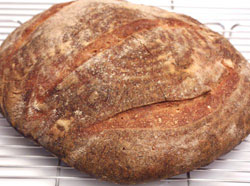
Country French (Pain de Campagne)
This traditional country loaf is by far one of the most popular breads to be found in every region of France and comes in a wide variety of shapes and sizes. It is made most often with a blend of whole-wheat, white, and rye and leavened with a natural starter. The crumb should have lots of big, irregularly shaped holes that come from a wet dough, lengthy fermentation, and gentle handling.
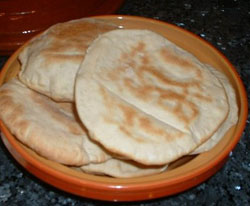
Flat Bread
A huge category of breads shaped as their name implies; they may or may not be leavened with yeast. Ethnic cuisines offer many styles, from Mexican tortillas to Middle Eastern pitas to Italian focaccia. The thinnest, such as lavash and tortillas, are used as casings for roll-up sandwiches at fast-casual restaurant chains such as Roly Poly.
Also see Flat Breads
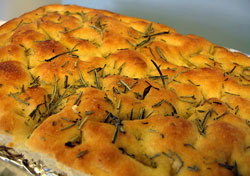
Focaccia (foh-KAH-chee-ah)
A yeast-leavened Italian flat bread flavored with olive oil and sometimes with herbs, thinly sliced onions, tomatoes or other ingredients before baking. Can be squarish, round or oblong; slice in half horizontally for sandwiches. Use at room temperature or grill it lightly, cut side down.
The Italian word focaccia means "under the fire" and it shares many of the same traits as pizza. However, focaccia is usually about 3/4 of an inch thick (versus the standard less than 1/2 inch thick pizza found in most parts of Italy) and is meant to be served at room temperature. Focaccia is also prepared with less toppings than traditional pizza including sea salt, rosemary, red pepper flakes, and other savory herbs.
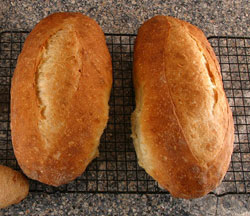
Italian Bread
Like French bread, Italian bread has a dark, hard crust and a slightly chewy interior. French bread is generally longer and narrower than Italian bread, but otherwise very similar.
See Difference Between Vienna, French & Italian Breads
Italian Bread recipe
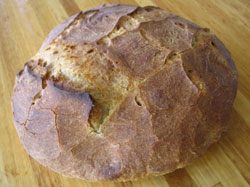
Pain au Levain
Covers a range of breads with one trait in common: all are leavened with a natural starter of wild yeasts and bacteria. This starter is "fed" through regularly scheduled additions of flour and water. Pain au levain usually comes in large, round loaves.
Puliese
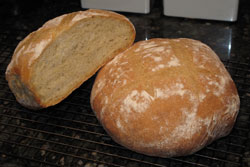
Puliese is a slightly irregular round bread that is roughly a foot in diameter. The loaf has a thick, dark crust with traces of flour left from the proofing (rising) cloth and an open, cream-colored crumb.
Sourdough
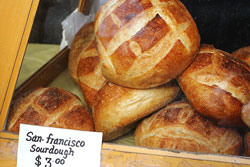
Sourdough is also a pretty wide classification. Sourdough usually refers to the classic San Francisco style sourdough bread made with a starter with bacteria and yeasts found only in the San Francisco Bay area. There are also delicious German-style sourdough wheat and rye breads, too. Sourdough bread often has a blistered crust with reddish-yellow tones. It has a distinct, sour flavor that's a byproduct of fermentation and is almost vinegary-tasting.
