German Christmas Cookies (Weihnachtskekse)
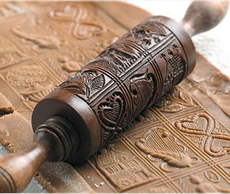
Modern Christmas Cookies can trace their history to recipes from Medieval Europe biscuits, which when many modern ingredients such as cinnamon, ginger, black pepper, almonds and dried fruit were introduced into the west. By the 16th century Christmas biscuits had become popular across Europe, with lebkuchen being favoured in Germany and papparkakor in Sweden, while in Norway krumkake were popular.
Cookies are loved throughout Germany, especially during the Christmas holiday. Cookies really began to gain popularity in Germany in the 1700's as an accompaniment to coffee and tea. They were, however, only a luxury the wealthy could afford due to the high price of sugar and other ingredients such as almonds and cocoa. This changed by the late 1800's when a less expensive sugar, derived from sugar beets, was made available. This allowed the less fortunate to bake cookies for special occasions.
Each region of Germany developed its own cookies, flavored with whatever spices were locally available. Today, cookies are most popular at Christmastime, when German pastry shops are filled with a profusion of cookie varieties, many of them decorated for the holiday.
The origin of the use of designs in German cookie making can be traced back to at least the 14th century in southeastern Germany and surrounding areas. Historians trace these cookies back to the Julfest, a midwinter celebration of pagan Germanic tribes. Julfest ceremonies included the sacrificing of animals to the gods, in hope that such offerings would bring a mild winter and an early spring. Poor people who could not afford to kill any of their animals gave token sacrifices in the form of animal-shaped breads and cookies. Vestiges of these pagan practices survive in the baking of shaped-and-stamped German Christmas cookies such as Lebkuchen, Spekulatius, Frankfurter Brenten, and Springerle.
Also see http://www.kitchenproject.com/html/german_christmas_baking.html
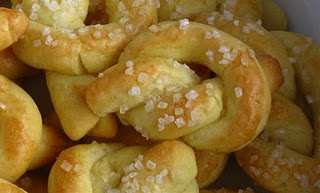
Berliner Kranser
Despite the name, these cookies are actually Norwegian in origin. Little shortbread cookies in the shape of a pretzel and studded with coarse sugar, sometimes colored.
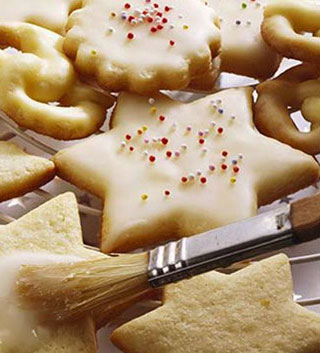
Butterplatzchen & Doppeldecker
As the name might suggest, butterplatzchen are cookies with a high proportion of butter in the dough. The dough is rolled out thinly, shaped using cookie cutters, and then decorated with icing or chocolate.
When two butterplatzchen are stacked together with jam between them, they become another type of cookie, a Doppeldecker.
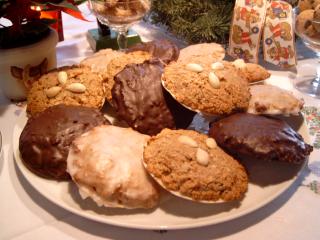
Lebkuchen
The forerunner of today's Lebkuchen was called the "honey cake" and its history can be traced back to the Egyptians, the Greeks, and the Romans. They believed that honey, the only sweetener widely available to them, was a gift of the deities and had magical and healing powers. Lebkuchen, also called Pfefferkuchen (lit. "pepper cake", with "pepper" referring to spices in general), are round or rectangular gingerbread cookies.
Unlike the thin, crispy, American-style gingerbread cookies, lebkuchen are thicker and softer. They often contain chopped nuts, or candied citrus peels. Many German regions have their own variations of lebkuchen; the most famous is the Nürnberger lebkuchen, which is baked on top a thin wafer called an oblaten. "Nürnberger Lebkuchen" have been baked in the city of Nürnberg since 1395 by the local monks. The use of the oblaten was an idea of the monks, who used unleavened communion wafer ingredients to prevent the dough from sticking. Typically, the lebkuchen are glazed or covered with very dark chocolate, but some are left uncoated.
Types of German Gingerbread (Lebkuchen)
"Nürnberger Elisen Lebkuchen", considered the finest kind of Oblaten Lebkuchen, must have a minimum 25% nuts and less than 10% flour by weight. Sometimes, the recipe includes marzipan. These are soft, moist drop cookies.
Nuremberg Lebkuchen recipe
Elisen gingerbread w/ marzipan & rum
Brown Lebkuchen are made with a stiff dough which starts with a honey or sugar syrup and are rolled and baked. The dough is either molded, cut or formed and is baked without oblaten (wafer).
Mom's Lebkucken (American version that uses molasses)
White Lebkuchen, a kind of Oblatenlebkuchen, has a higher percentage of egg (at least 15%) and not more than 40% flour. They are decorated with almonds and candied orange or lemon peel. Lebkuchen is often referred to as "Pfefferkuchen".
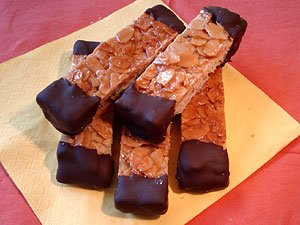
Mandelschnitten
Almond cookies that are a favorite everywhere. The dough is rolled out, then covered with an almond, honey and butter mixture before baked. In the picture to the left, the ends are dipped in chocolate, a recent variation.
Mandelschnitten recipe
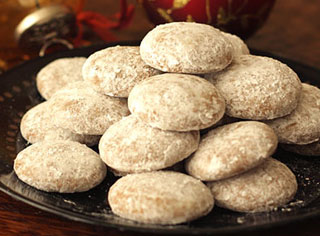
Pfeffernusse
Pfeffernüsse are small, hard, round biscuits with ground nuts, often dunked in wine or other beverage. The name translates to "pepper nuts" in German, Danish and Dutch, describing their spicy taste as well as the fact that many recipes actually call for almonds or walnuts and a small amount of black pepper to be used.
Pepernoten are originally a Dutch treat, baked during 'Sinterklaas', a feast on 5 December (6 December in Belgium and Germany) on which little children receive gifts from the holy St. Nicholas, the partial inspiration for Santa Claus. In Germany, Pfeffernüsse are traditionally made during the Christmas season.
German Pfeffernüsse are often confused with Russian tea cakes because they are a similar shape and are both generally covered in powdered sugar, but they are different internally.
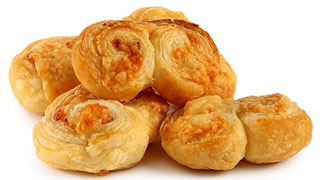
Schweineohrchen
Also known as Palmers, schweineohrchen---which translates as pigs' ears---are crispy, delicate cookies made of puff pastry that has been rolled and then sliced. After baking, the cookies are sometimes dusted with confectioners' sugar or dipped in chocolate.
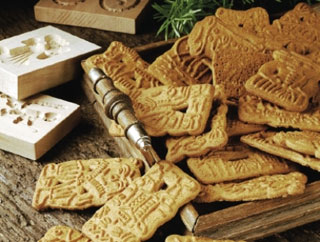
Spekulatius or Speculaas (Dutch) - Dutch Windmill cookies
Spekulatius is a traditional Christmas cookie that originated in the Netherlands and is made using a cookie mold that presses a design into each cookie, often a windmill or a barnyard animal. Crispy and thin, spekulatius are often spiced with cardamom, cinnamon, and nutmeg, or coated with sliced almonds. Spekulatius is related to the Latin word "speculum", meaning mirror. Since the cookies are formed in a bas relief carved wooden mold, a mirror image of the mold becomes the cookie.
Spekulatius is a type of shortcrust biscuit, traditionally baked for consumption on St Nicholas' Eve in the Netherlands (December 5) and Belgium (December 6). In recent decades it has become available all year round. Spekulatius are thin, very crunchy, slightly browned and, most significantly, have some image or figure (often from the traditional stories about St. Nicholas) stamped on the front side before baking; the back is flat. Common Spekulatius figures from the St. Nicholas legends are a windmill, a ship, a farmhouse, an elephant, and a horse.
Spekulatius dough does not rise much. Dutch and Belgian versions are baked with light brown (beet) sugar and baking powder. German Spekulatius uses baker's ammonia as leavening agent. Spices used in Spekulatius are cinnamon, nutmeg, cloves, ginger, cardamom and white pepper. Most Spekulatius versions are made from white flour, brown sugar, butter and spices. Some varieties use some almond flour and have slivered almonds embedded in the bottom. Belgian varieties use less or no spice and are sold as speculoos. In the United States, New Zealand and Australia, speculaas are often sold as Dutch Windmill cookies.
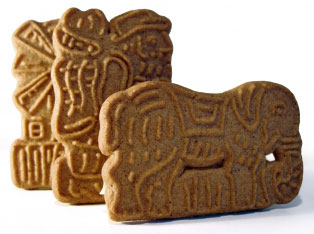
Traditional Spekulatius designs include an elephant,
St. Nicholas and a windmill
There are 3 types of Spekulatius cookies:
- Spice Spekulatius (Gewürzspekulatius): This is the most common type of Spekulatius cookie. It obtains its taste from the spices cardamom, cloves, and cinnamon.
- Almond Spekulatius (Mandelspekulatius): This is a Spekulatius cookie, in which the bottom of the cookie is coated in almonds. These are also known as Mandel-Kichelchen.
- Butter Spekulatius (Butterspekulatius): This is a Spekulatius cookie which is made with a high amount of butter.
Spekulatius recipe (Dutch Windmill Cookies)
Springerle
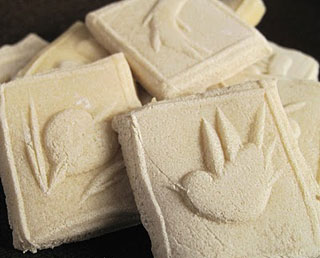
Springerle are traditional Christmas cookies that have been made in Bavaria and Austria for centuries. They are white, anise-flavored cookies, made from a simple egg-flour-sugar dough. Usually rectangular or circular in shape, they have a picture or design stamped on the top. The images are imprinted with specially carved Springerle Rolling Pins or flat molds (Springerle presses or boards).
After the springerle are molded, the dough is allowed to harden for a few hours, so that the design isn't lost during baking. Once baked, the designs are sometimes enhanced with edible food colors, tempera,or acrylic paints if the cookies are to be used as decorations.
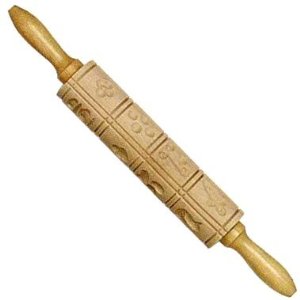
Springerle Rolling Pin
The name Springerle comes from an old German dialect and means "little knight" or "jumping horse." Historians trace these cookies back to the Julfest, a midwinter celebration of pagan Germanic tribes. Julfest ceremonies included the sacrificing of animals to the gods, in hope that such offerings would bring a mild winter and an early spring. Poor people who could not afford to kill any of their animals gave token sacrifices in the form of animal-shaped breads and cookies.
Vestiges of these pagan practices survive in the baking of shaped-and-stamped German Christmas cookies such as Lebkuchen, Spekulatius, Frankfurter Brenten, and Springerle. Scenes from the Bible were some of the earliest images portrayed on the springerle molds. and were used to educate those who couldn't read or write. Eventually, other scenes were carved and the cookies soon reflected images of holidays, events, and scenes from every day life. The cookies were also used to celebrate births, weddings, and used as betrothal tokens. Exchanging springerle during the holidays was a common practice very much like we exchange cards today.
Spritzgeback (Spritz)
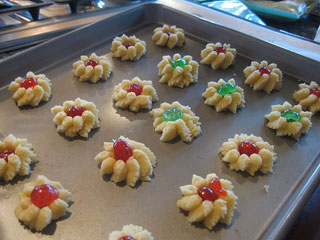
Spritzgeback, also called Spritz, are crisp, buttery cookies made with a cookie press, often in the shapes of stars or flowers. For Christmas, they're topped with maraschino cherry halves, sprinkles, or a flavored icing such as vanilla or rum.
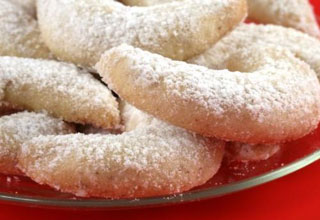
Vanillekipferl
Kipferl originate from Vienna, Austria. However, the delicious sickle-shaped cookies have been baked in Germany for Christmas for a long time. They are usually made with ground almonds or hazelnuts. They are flavored with vanilla or artificial flavouring and have a heavy dusting of powdered and superfine sugar. Although, at first, the Vanillekipferl appears to be a modest, little biscuit among all the colourful and sometimes elaborately decorated Christmas biscuits, it is a clear favourite. What makes the Vanillekipferl so special is its flavour: a unique combination of vanilla and almonds.
Traditionally, they are made at Christmas, but they can be enjoyed all year round and are often for sale in Viennese coffee shops. They are also widely baked in Germany and are common in Hungary, Czech republic, Romania and Slovakia as a part of the typical Christmas baking.
The origins of the shape go back to the time of the Austro-Hungarian Empire. When the Ottoman Turks stormed the city of Vienna, it was the bakers who raised the alarm, and thus saved the city from invasion. As the story goes, these bakers formed the Kipferl to symbolize the Turkish crescent moon and celebrate having successfully avoided an invasion.
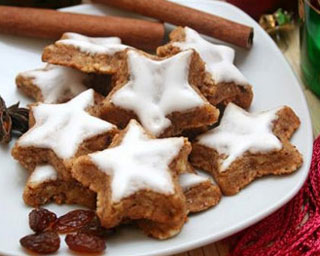
Zimtsterne
Zimtsterne is German for cinnamon stars, and that's exactly what these are: flat, star-shaped cookies flavored with cinnamon. Zimtsterne are nut meringues sometimes decorated with vanilla icing or sprinkles.
Zimtsterne are found in Switzerland, Austria and Germany where they are also known as "Erstesstern" meaning "first star" (the German Jewish communities bake them for Yom Kippur, the "Day of Atonement"). These nut meringues are crunchy on the outside, but deliciously mellow in their center. It's a classic Christmas biscuit that will enchant everybody with it's interesting spiciness. Zimtsterne also make an ideal gift.
