Asian Noodles
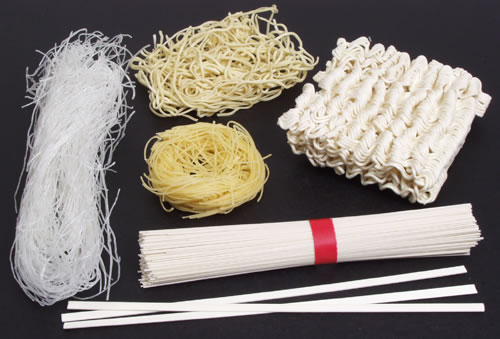
Asian noodles consist of strands that vary in shape, width and length. Many Asian
noodles are very long in length, symbolizing longevity. They are also found as thin
straight sticks, flat strands, round strands, and wavy strands.
They are found in bundles of sticks, bundles of long noodles, and nests of long coiled noodles. They are generally found in dried form but can be found fresh in some Asian markets.
Asian noodles are often partially boiled and then fried, or added to stir-fries and soups. Some are soaked in hot water for a short period of time instead of being boiled. Some of the Asian noodles can also be deep-fried. Fried noodles are added to salads to provide a crunchy texture. Asian noodles add a variety of textures to dishes they are added to. Depending on the variety of noodle and the method used to cook them, their texture may be soft, crunchy, rubbery, or chewy. They are not often eaten as a side dish on their own.
Noodles are all loosely called “mien” in Chinese, “men” in Japanese, “myun” or “gooksu” in Korean, “bún” in Vietnamese, and “sen” in Thai.
When shopping for a particular Asian noodle, you may have difficulty finding it in your local food store because they may stock only a limited variety. You may have to try to find it in an Asian market or substitute a more available variety. Check your recipe for suggested substitutions. There are generally several varieties that can be substituted.
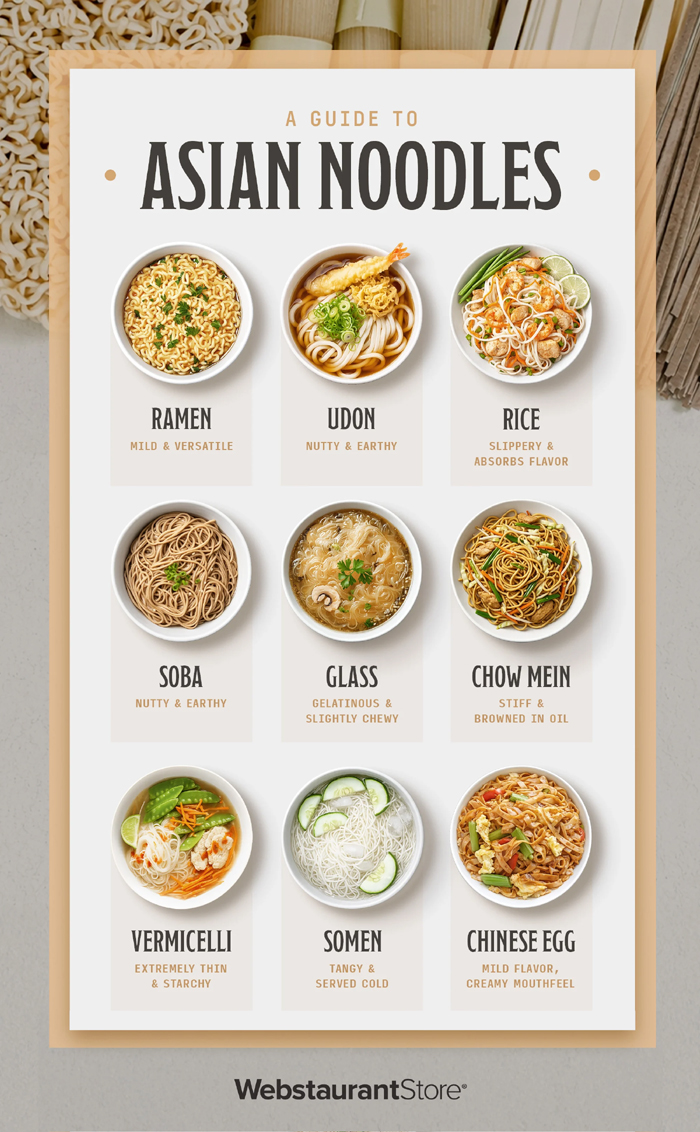
General Types of Asian Noodles (popular in the US)
from https://www.webstaurantstore.com/
People often confuse pasta and noodles. Pasta, the signature dish of Italy, is made from durum semolina, a tetraploid species of wheat with a yellow endosperm and a coarser texture than common wheat. Pasta artisans extrude pasta dough into various shapes by forcing the dough through a shaped opening (not unlike what you did as a child with Play-Doh). In contrast, Asian noodle makers string, spin, or cut their noodles. Traditionally, Asian noodles are made with flour milled from common wheat, rice flour, or starch from a tuber or bean. Because traditional Asian noodles use softer flours and starches than pasta, most noodles employ salt as a binding agent, whereas Italian pasta typically forgoes salt.
You can broadly categorize Asian noodles into three main types: wheat, rice, and glass noodles. However, there is a surplus of subcategories with distinct preparation methods, ingredients, shapes, and sizes. Reducing this dynamic cuisine to three unnuanced categories won’t help you navigate the Asian noodle aisle. Our guide to the ten most popular Asian noodles breaks down flavor, texture, and uses so you can find the soft, springy, or slippery Asian noodle that satisfies your needs.
Ramen
Ramen noodles were made famous by ramen soup, a brothy umami-rich dish loaded with proteins, vegetables, and spices. Ramen noodles are composed of wheat flour, salt, water, and kansui. A type of mineral water, kansui contains sodium carbonate, potassium carbonate, and may contain phosphoric acid.
Kansui imbues ramen noodles with their signature yellow hue and distinguishes them from other types of Japanese noodles. It also stiffens the noodles, inhibiting moisture absorption, and preventing them from becoming soggy in soup recipes.
Udon Noodles
Udon is a Japanese wheat-based noodle with a dense, chewy texture and little flavor. There are regional varieties that range in thickness, smoothness, and width. Udon has a signature white color no matter its regional rendition. You can purchase fresh or dried udon noodles to suit your recipe and storage needs. Dried udon noodles typically resemble fettuccine in shape and size. Fresh udon noodles often have rounder, plumper shapes.
Commonly served in hot broth, udon is considered comfort food. Udon also acts as a base for Japanese curry, is served cold with dipping sauce, and is incorporated in noodle salads. Popular toppings for udon dishes are green onions, shredded seaweed, and Japanese chili flakes. Udon noodles are popular throughout Southeast Asia and are the signature ingredient in the famous Korean dish, jajangmyeon.
Lo Mein vs Udon
The biggest difference between lo mein and udon is that lo mein is made with egg noodles and udon is a wheat noodle. Most udon noodles are wider than lo mein egg noodles. The addition of eggs makes lo mein noodles chewier than udon, and they hold up better in pasta dishes. The plain wheat-based udon noodle absorbs broth and is perfect for soups.
Rice Noodles
You can loosely categorize Asian rice noodles under the Cantonese word fun or fen. Most Asian rice noodles are made from simple recipes of rice flour and water. From 5 cm long and 5 mm wide silver needle noodles to inch-wide chow fun noodles, Asian rice noodles come in all shapes and sizes. Rice noodles are the staple of many famous dishes like Singapore noodles, pho, and pad Thai. The same basic recipe is used to make rice paper for Vietnamese summer rolls. (more information below)
Rice Noodles vs Lo Mein
Lo mein noodles are made of wheat flour, water, and egg. Rice noodles are made with rice flour and water. If you’re looking for a slippery noodle to absorb the flavor of your sauce or broth, then rice noodles are the right choice for you. If you want a chewy, creamy noodle that makes a great base for pasta dishes, then lo mein (or another Chinese egg noodle) is the right fit for your recipe.
Soba Noodles
Soba noodles are Japanese noodles made with buckwheat flour and water (soba is the Japanese word for buckwheat). Many varieties use a percentage of whole wheat flour to make the noodles sturdier. Pure buckwheat soba is called ju-wari soba, and 80% buckwheat soba is known as hachi-wari soba. For authentic, high-quality soba noodles, check the label and make sure they have at least 70-80% buckwheat flour.
Soba noodles are higher in protein and fiber than other types of Asian noodles. People use them in hot noodle dishes, cold noodle salads, and brothy noodle soups. Soba noodles are an easy and delicious way to accommodate gluten-free patrons, just make sure the noodles you’re using are 100% buckwheat (ju-wari soba).
Glass Noodles (cellophane noodles or bean thread noodles)
Also known as cellophane noodles or bean thread noodles, glass noodles are skinny, long noodles made from water and starch derived from beans and tubers. Noodle makers use mung bean starch, sweet potato starch, tapioca starch, pea starch, and potato starch to make glass noodles. They are a gluten-free alternative to wheat-based noodles and pasta. Check the label and confirm they weren’t exposed to gluten during manufacturing before purchasing glass noodles for your gluten-free menu.
Glass noodles are not always transparent; their color varies by the starch used. The most common type of glass noodle comes from China and is made with mung bean starch. Glass noodles made from sweet potato starch dominate the Korean and Japanese noodle market. Tapioca noodles are extremely popular in Vietnam and are used to make the Central and Southern Vietnamese dish, crab tapioca noodle soup. (more information below)
Chow Mein Noodles
Mein is the Chinese word for noodles, and chow means fried, so chow mein simply means fried noodles. The noodles used in chow mein dishes are usually egg noodles browned in oil on both sides, earning them the nickname “twice-browned noodles". There are two main types of chow mein: steamed chow mein and crispy chow mein. To make steamed chow mein, chefs flash fry the egg noodles before tossing them with the rest of the ingredients and coating them in a light sauce. For crispy chow mein, chefs press the noodles flat while frying them.
The chow mein dish you’ll find on most Chinese food menus was created by Chinese Americans. It evolved from an authentic dish known as ch’ao mien, aka “stir-fried noodles”. In American Chinese cuisine, chow mein is known as a specific dish made with egg noodles, meat, and vegetables bathed in a dark, thick, soy-based sauce.
Vermicelli Noodles
The term vermicelli encompasses a broad category of thin Asian noodles. The noodle must have a diameter of less than 0.06 inches (1.5 mm) to be classified as vermicelli. The most popular type of Asian vermicelli noodle is rice vermicelli. Rice vermicelli noodles are known as bee hoon in Hokkien Chinese, mai fun in Cantonese Chinese, wunsen in Thai, kya zan in Burmese, and bun in Vietnamese.
Since vermicelli designates size, not ingredients, you'll encounter different types of vermicelli noodles dominating regional and national sales landscapes. There are rice, wheat, mung bean, potato starch, and tapioca vermicelli varieties. In Vietnam, vermicelli noodles are the same as angel hair pasta. In China, you’ll find wheat vermicelli (misua) and various mung bean vermicelli noodles. Thailand is famous for its mung bean vermicelli, pad woon sen.
Somen Noodles
Somen noodles are wispy (less than 0.05 mm in diameter), pale, Japanese wheat noodles made from superfine wheat flour, salt, and water. After it’s hand-stretched into thin strips, somen noodle dough is coated in vegetable oil to prevent over-air-drying. Due to their thread-like consistency, you can cook somen noodles in under 3 minutes in boiling water; because the noodles contain salt, don’t salt the water before boiling them. Once cooked, rinse the somen in cold water to remove the oil.
Summers in Japan are sweltering, and slurping cold somen noodles is a popular way to cool down. Cold somen noodles are dipped in umami-rich tsuyu sauce made by combining soy sauce, rice wine, sake, dried kelp, and dried bonito flakes. Many restaurants create an interactive serving experience known as nagashi somen. Invented after World War II, restaurants serve nagashi somen by dropping somen noodle clusters into a chute of running water. Patrons scoop the somen clusters out of the water with chopsticks as they float down, and then dunk them in a sauce. Somen noodles are enjoyed in hot soups and stir-fries during the colder months.
Chinese Egg Noodles
Chinese egg noodles, also known as egg noodles, are timeless Asian noodles composed of wheat flour, water, and eggs. You can find egg noodles shaped into both thick and thin strands. Chinese egg noodles are beloved for their springy, chewy consistency. They are the staple ingredient in classic Chinese meals like chow mein, wonton soup, and lo mein. Some retailers cut corners and use food coloring to tint their noodles instead of eggs, so check ingredient labels to confirm you’re getting authentic egg noodles.
Chinese egg noodles are distinct from the German egg noodle pasta known as spaetzle. Irregularly shaped and short, spaetzle is usually made with semolina flour, milk, and eggs. Spaetzle has a consistency reminiscent of a dumpling. In contrast, classic Chinese egg noodles are long, thin, and uniform. They are either round or flat and provide a springy, chewy texture. You cannot use these two distinct ingredients interchangeably.
Cellophane Noodles (bean thread or glass noodles)
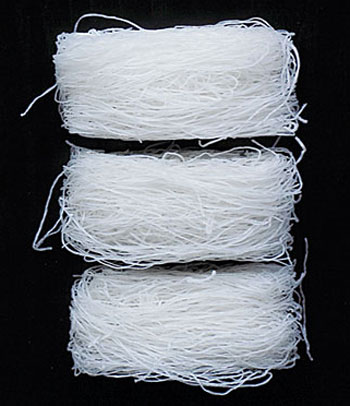
Also called bean threads, slippery noodles, or even bean vermicelli, cellophane noodles are made from mung bean starch. Cellophane noodles work well in soups and stir-fries, absorbing the flavor of the foods they are cooked with. When deep-fried fried they puff up and become quite crispy.
These slender, gelatinous noodles are widely used throughout China and Southeast Asia. They're made from mung beans and almost flavorless, though they readily absorb other flavors. They're commonly used in soups, stir-fries, salads, desserts, and even drinks.
Before using, soak them in hot water until they're soft and transparent (about 15 minutes - they will droop completely; if they’re still trying to hold their original shape, they’re not ready), then add them to boiling water and cook them for no more than a minute. Rinse them in cold water and drain.
The dried noodles can also be deep fried to make a crunchy garnish or bed for sauces.
Shrimp Ball Soup with Cellophane Noodles
Wheat Flour Noodles
Wheat is the most commonly used ingredient in Chinese noodles and many other Asian countries. Wheat noodles are now common all over China, although they originated in the northern provinces where wheat is grown in preference to rice which cannot survive the cold winters of that region. Generally speaking, wheat noodles can be divided into two broad classes: plain noodles which consist of wheat, water and salt, and egg noodles which are made from wheat, water, salt, eggs and perhaps other ingredients.
Both types are available fresh (or frozen) and dried in the marketplace, and whichever one is used depends on the recipe and the taste of the cook who is presiding over the stove. They are packaged either straight in boxes or bags, or, more often, coiled together into little nests which represent a convenient serving size, which varies according to the width of the noodle. The fresh ones are very long and are coiled into bundles which are then either vacuum packed or wrapped in cellophane or plastic bags.
Plain wheat noodles are creamy or greyish white in color, and cook up to a soft ivory color. Whether fresh or dried, they tend to cook quite quickly, so it is best to avoid overcooking them. The plain wheat noodles are softer and more delicate than noodles made with flour and egg and are mostly used in soups.
They come in various sizes, some as thin as vermicelli, others as thick and wide as fettuccine. The thinner varieties are often used in light soups, while the thicker ones work well in thicker soups and stir-fries. Boil before using.
Egg Flour Noodles
These wheat noodles are made with eggs, which adds flavor, color, and body. Unlike the plain noodles that are made of flour and water, egg noodles have a more springy texture when you chew them. It is the protein in the eggs that contribute to the springy texture. Moreover, egg noodles are good for stir fries as they don’t get mushy easily.
Egg noodles are available both fresh and dried. Fresh or dried, you'll usually know these noodles by their yellow color. Made with eggs, wheat flour, and water, they come in a number of widths and shapes, from the thinner vermicelli to flat thicker noodles. Instant Ramen noodles are a type of egg flour noodle. Used in soups and stir-fries, they need to be boiled before using.
Cook fresh noodles in boiling water for about 3 minutes, dried for about 5 minutes.
Rice Noodles
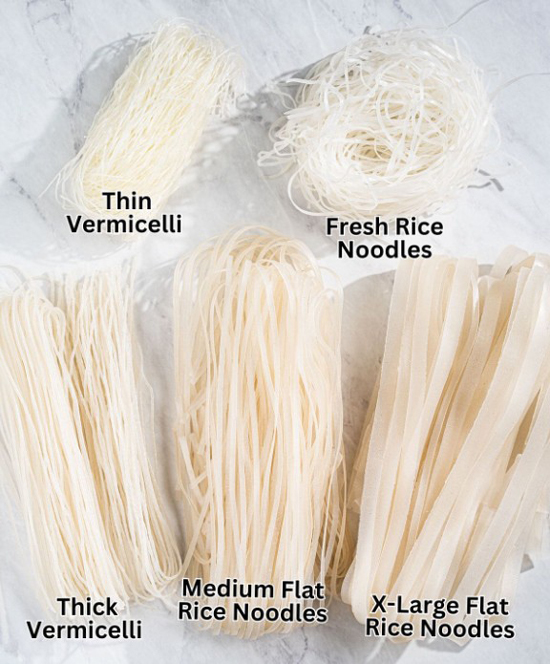
Made from rice flour and water, these thin, almost transparent noodles are used in many Asian cuisines, but will be found most frequently in Vietnamese, Thai, and Filipino dishes. Rice noodles are an excellent choice if you are gluten intolerant, as they are gluten free, having no wheat flour. Some brands add tapioca or cornstarch for extra chew.
A large variety of rice noodles are available, from thin rice vermicelli to the thick broad flat noodles used in stir-fries and heartier soups. Rice Sticks come in many shapes and sizes, but they can be roughly classified as thin, medium, and wide.
- Thin rice noodles are used in soups, salads, and spring rolls.
- Medium noodles are the most versatile, and can be used in soups, stir-fries, salads, or as a bed for meat or fish. Medium sized rice noodles, called Banh Pho, are used to make Vietnam's popular Pho soup, and Thailand’s most famous rice noodle dish, Pad Thai, stir fried noodles with shrimp.
- Wide noodles are best used in soups, stir-fries where you want chewy noodles that won’t break apart, and braised dishes.
Soak the noodles in hot water for fifteen - twenty minutes to soften them, depending upon the thickness of the noodles (this helps noodles cook evenly and prevents breakage), and then run cooler water over them from the tap. Rice noodles need care in preparation or they quickly become a sodden sticky mass. The noodles should be soaked in the broth for soups, not boiled. Rice noodles are also formed into rice cakes, which can be served with dipping sauces and salads.
Rice vermicelli - These are used throughout Asian in soups, spring rolls, cold salads, and stir-fries. They're similar to bean threads, only they're longer and made with rice flour instead of mung bean starch. Before using, soak the dried noodles in hot water until they're soft (about 15 minutes), then boil them briefly (from 1 to 3 minutes) and rinse with hot water. If adding to a stir-fry or a soup, do not boil them; they will further cook in the dish. You can also deep-fry the dried noodles until they're crunchy and then use them in Chinese chicken salad, or as a garnish or bed for sauces. Substitutes: thin rice sticks OR bean threads OR flat rice noodles (wider) OR vermicelli
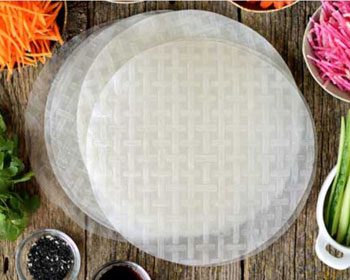
Rice Paper
Rice Paper
Also made from rice flour and water, rice papers are available in either round or triangular form. The unique patterning on each paper comes from their being dried on bamboo mats in the sun. Available only in dried form, they are firm and must be softened in hot water before use.
In Chinese cooking there is a trend towards using them instead of cellophane to make Paper Wrapped Chicken; in Vietnamese cuisine rice papers (Banh Trang) are used to wrap crispy fried spring rolls, as well as summer rolls where the rice papers are soaked and softened, then wrapped around cold ingredients such as fresh herbs, cooked rice vermicelli, shrimp, shredded carrots, and cucumber strips.
Noodles by Country (in alphabetical order)
Chinese noodles = mein = min = mian
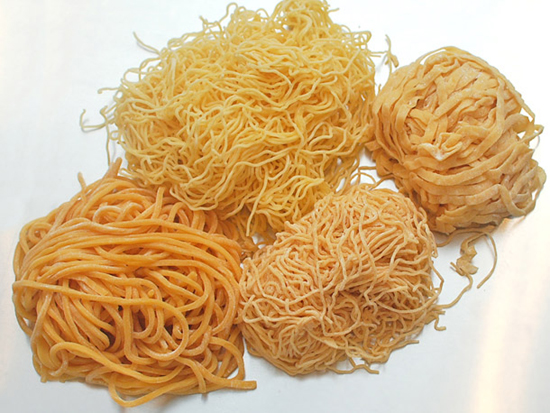
Clockwise from top left: Hong Kong-Style chow mein noodles,
wide wonton noodles, thin wonton noodles, low mein noodles
Also see Chinese Noodles
The Chinese like their noodles long and slippery, the better to slurp down noisily. They are usually served uncut because long noodles symbolize a long life in Chinese tradition. Noodles are commonly served at birthday celebrations, and fresh noodles are regularly placed at gravesites. In China, making "hand-pulled" noodles is an art involving holding the stretched out paste in both hands and whirling it around several times. Then the paste is laid out on a board and folded and refolded repeatedly. Eventually the paste is transformed into long, thin, noodles. While in China it is still possible to watch vendors make hand-pulled noodles, today most noodles are made by machine. Noodles are eaten hot or cold, steamed, stir-fried, deep-fried, boiled, or served in a soup.
Chinese egg noodles are available fresh, dried, and frozen in Asian markets; and some are flavored with shrimp. Some brands are labeled "imitation noodles"; these aren't made with eggs, but have yellow food coloring added.
They're especially fond of wheat noodles, which they use in soups, and wheat and egg noodles, which they use in stir-fries and chow mein, their famous fried noodle dish. While today wheat flour noodles are enjoyed throughout China, they originated in the north, where wheat is a staple crop. Arrowroot or tapioca starch are sometimes added to the flour mixture in low quantities to change the texture and tenderness of the noodles' strands. Wheat noodles come in a number of widths and shapes, from the thinner vermicelli to flat thicker noodles. Use the flat ones for stir-fries and the round ones for soups, they need to be boiled before using.
Sometimes people wonder about the difference between lo mein and chow mein noodles. Actually, the difference between the two lies not in the type of noodles used (both are made with Chinese egg noodles), but in the way the two dishes are prepared. Chow mein noodles are usually cut a bit thinner than lo mein noodles, but the two can be used interchangeably. In the case of chow mein, the ingredients are stir-fried and then served over noodles that have been prepared separately. By contrast, lo mein involves tossing boiled noodles in the wok and mixing them with other ingredients during the final stages of cooking. This allows the noodles to pick up more of the sauce flavor. Chow = fried. Lo = tossed.
Hong Kong Style Noodles - noodles labeled "Hong Kong" or "pan-fried noodles" are par-cooked in boiling water, which makes them ready to stir-fry. If you can't find Hong Kong noodles, you can substitute thin wonton noodles. Boil them in water until they're just barely tender (under a minute), drain and carefully dry them (you don't want any excess moisture if you're planning on stir-frying), and then toss 'em with just a bit of oil.
For further information, see What is the Difference Between Lo Mein, Chow Mein, Chow Fun and Mei Fun?
Wonton noodles come in two basic sizes. Thin wonton noodles are perfect for dishes like this wonton noodle soup with chicken and shiitakes where the broth is light and delicate. Think chicken soups or wonton soups made with a mixture of pork and seafood. They're also great in very simple dishes cooked with ginger and scallions or oyster sauce; any dish where the noodle is really the star. Use wide wonton noodles for heartier noodle soups, like Taiwanese beef noodle soup, or other dishes with braised beef and heavier, oilier flavors.
American Crispy Chow Mein Noodles. These fried noodles add crunch to Chinese chicken salad. They're also used, improbably enough, to make Chocolate Haystack Cookies. Don't confuse this with Chinese wheat noodles, which are also sometimes called chow mein noodles. You can serve them on top of a stir fry as a garnish, or under the stir fry for a different taste and texture to boiled noodles.
Substitutes: rice vermicelli (Deep fry these until crunchy.) OR Cook spaghetti, then deep-fry a few noodles at a time until golden.
Rice noodles are more typical of southern China. Made with rice flour and water, a large variety of rice noodles are available, from thin rice vermicelli to the thick broad flat noodles used in stir-fries and heartier soups. The term “rice sticks” can refer both to the thinner noodles as well as medium-sized and thicker flat noodles. Rice noodles should be soaked in hot water for fifteen - twenty minutes before using. Medium sized rice noodles, called Banh Pho, are used to make Vietnam's popular Pho soup.
Cellophane noodles, also called bean threads, slippery noodles, or even bean vermicelli, are made from mung bean starch. Before using, soak them in hot (not boiling) water. Cellophane noodles work well in soups and stir-fries, absorbing the flavor of the foods they are cooked with. When deep-fried fried they puff up and become quite crispy.
Filipino noodles = pancit noodles
Pancit, also spelled pansít, is a general term referring to various traditional noodle dishes in the Philippines. There are numerous types of pancit, often named based on the noodles used, method of cooking, place of origin, equal and constant diameter or the ingredients.
Pancit is most commonly cooked by sautéing them with garlic, onions, vegetables, and meat or seafood. Rarer ingredients include kamias, coconut milk, banana blossoms, mustard greens, okra, calabaza, tengang daga mushrooms, and shitake mushrooms. The ingredients of the sauce varies by recipe. These ingredients include soy sauce (or salt), vinegar, fish sauce (patis), bagoong alamang (shrimp paste), taba ng talangka (crab fat), oyster sauce, bugnay wine, fermented soy bean paste, and various sweet sauces (including inihaw sauces).
Pancit Canton is often described as a cousin to Chow Mein and Lo Mein, which is a stir-fry noodle dish that many of us who love Chinese food grew up eating. They are definitely quite similar, however, there are a few main differences. One is in the noodle itself. Chow mein noodles are egg noodles, whereas Pancit Canton noodles are wheat flour noodles, though depending on the brand of pancit canton noodles you purchase, some contain egg powder. Some prefer the plain wheat flour noodles for its bite and texture. The other main difference is in the preparation. When making Pancit Canton, the dry noodles are added to the broth towards the end of the dish, and no pre-boiling is necessary. With chow mein and lo mein, the noodles are boiled (or fried) and drained first (like making spaghetti), then added to the stir-fry after.
The most commonly used noodles are canton (wheat noodles, bihon (rice vermicelli), lomi (thick egg noodles), miki (soft yellow egg noodles, usually square in cross-section), misua or miswa (wheat vermicelli), palabok (yellow cornstarch noodles), sotanghon (glass noodles), and odong (yellow flour noodles).
Filipino Dishes - Different types of pancit are classified primarily by the kind of noodles used.
- Pancit Canton - a type of Lo Mein or tossed noodles. Canton noodles are made with wheat flour, coconut oil, and yellow food coloring.
- Pancit Luglug - made with cornstarch noodle. The term "luglug" means to rinse or to wash. Before using, soak them in hot water until they're soft. The dish got its local name because of the way it is served. Wherein the (precooked) noodles are placed on a strainer and plunged repeatedly in hot or boiling water before dumping them on a plate to be smothered with the sauce and various toppings.
- Pancit Palabok - made with a thin rice noodle called bihon
Indonesian noodles = mi = mie
Indonesians like to use bean threads (which they call su un), and rice vermicelli. They also use egg and wheat-flour noodles to make bami goreng, a fried noodle dish.
- bean threads (cellophane noodles)
- rice vermicelli
- egg and wheat-flour noodles
Japanese noodles = menrui
Also see Japanese Noodles
Ramen (pronunciation: RAH-min OR RAH-mane) - A Japanese wheat noodle that started life in China, fresh ramen are thin and very long, with a pronounced chew and yellow colour. Most noodles are thought to have originated in China, but they’ve been a central part of Japanese cuisine and culture for centuries. Japanese noodles are a staple in countless regional dishes, offering a variety of flavours, textures and culinary experiences.
These commonly wheat-based noodles tend to be long and thin, usually dried in blocks. Ramen is usually served in some kind of broth with an array of toppings like chashu pork, boiled eggs, seaweed, tofu and much more.
You can find bricks of instant ramen in many supermarkets, packaged in cellophane along with seasoning packets which you can use or discard. A staple of Japanese salarymen and American college students, these Japanese noodles can be used in soups or salads. These noodles are usually fried in oil before they're dried, so they tend to be high in fat. They cook in about 2 to 3 minutes. Asian stores also carry fresh or frozen ramen noodles.
Chuka Soba Noodles - These are Japanese ramen noodles that are dyed yellow and usually lower in fat.
Udon (pronunciation: oo-DOAN) - These slippery Japanese wheat noodles are much thicker than ramen and have a softer, chewy texture. They are popular in southern Japan, where they're often served hot in soups or stews (though they’re also served in cold dishes in summer). They are also a good contender for stir fries. Their neutral flavour makes them a great foil for strong flavours like soy sauce and ginger.
Dried udon noodles are available in Asian markets and health food stores. They're roughly as thick as spaghetti, but they come in different widths. Cook them for about 11 minutes. Fresh udon noodles are called nama udon. Find them, pre-cooked, in vacuum packs of 200 g portions. Before using they need to be refreshed by soaking for 2-3 minutes in a bowl with plenty of boiling water- use chop sticks to untangle them as they soften then drain them well before using.
The simplest and one of the most delicious ways to serve them is in a clear chicken broth, with soy sauce, ginger and a few drops of sesame oil added. There are many famous udon dishes, such as Yaki-Udon, stir fried noodles with pork and vegetables.
Soba = buckwheat noodles (pronunciation: SO-bah)
These chewy Japanese noodles are popular at soup counters in Tokyo. They're made with a blend of wheat and buckwheat flours, the more buckwheat the better, and are brown in colour. They have a slightly earthier taste than ramen or udon. They're often sold fresh (called nama soba) in Japan, but foreigners usually have to settle for dried. Soba comes in different widths and flavors, including green cha soba = chasoba, which is flavored with green tea, and yamaimo soba, flavored with yams. Cook them for about 3 minutes.
They are frequently used in cold dishes or noodle salads accompanied by a dipping sauce. However, their versatility means they can also be used in a hot broth for delicious results.
Yakisoba - Despite the name, these are not buckwheat noodles and are instead made with wheat flour. Like ramen, they are long and thin and are used in yakisoba stir-fry dishes. They are commonly flavoured with Worcestershire or barbeque-flavoured sauces and accompanied by things like pork, shredded cabbage and bean sprouts. In Japan, you’ll see plenty of street food vendors serving up devious servings of yakisoba.
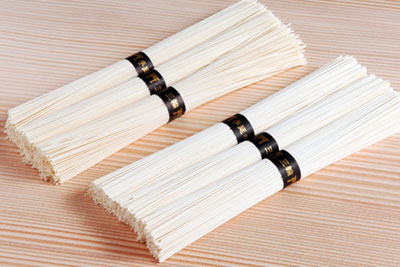
Somen (pronunciation: soh-mane)
Elegant, dried Japanese wheat noodles made very thin by stretching the dough - vegetable oil is used to facilitate this and originally the process was by hand. These days, somen are mainly machine-made. Once formed, the noodles are air dried. They’re almost always served cold in summer months, with a light dipping sauce based on katsuobushi (better known as bonito flakes) to the side although they’re also served in hot broth and in stir fries too.
Sold in packs of individually bundled portions, you sometimes can even find coloured ones. For example, coloured green with macha powder, yellow/orange with carrot or egg yolk or pink, from shiso oil. Cha somen is colored with green tea, and tomago somen is flavored with egg yolks.
Cook them for about 2 or 3 minutes. If you have too little water or you do not stir quickly enough, the somen will tend to become a huge lump just like dango i.e. rice balls. Get rid of the sliminess by washing the somen in cold water. Upon cooking, there is this slimy sensation on the somen which can be removed by washing it under running water. If this step is skipped, the somen loses its springy texture and shine. Once the somen is cool, it can then be served directly or placed in a bowl of ice.
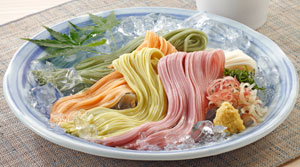
Colored Somen on ice
With regards to the tsuyu (つゆ) i.e. dipping sauce eaten with the somen, there are three common versions. One is the basic type which is made of mirin, soy sauce, and water. The sesame version uses the same ingredients as well but has bonito flakes, oil from white sesame, and vinegar. Last but not least, the miso version uses salad oil, red miso, dashi, sugar, grated ginger, and cayenne pepper powder. As such, depending on your preferences, you can choose to match your somen with any of these three types of tsuyu.
The hiyashi somen is a relatively simple dish since it contains only the somen, tsuyu, and condiments such as spring onions and grated ginger. However, you don’t have to limit yourself to these ingredients and you can put in your favorite items such as omelet, cucumber strips, and prawns.
Harusame = Japanese vermicelli = harusame saifun = harusame sai fun (pronunciation: hah-roo-SAH-may)
These thin, translucent Japanese noodles are typically made with potato, sweet potato, rice, or mung bean starch. and tend to be incorporated into soups, hot pots and salads. Harusame noodles are also often used as a filling in spring rolls. ‘Harusame’ translates to ‘spring rain’, a name that reflects the transparent, almost watery appearance of the noodles. You may also see harusame noodles referred to as glass noodles for this reason. They're similar to Chinese bean threads.
Substitutes: bean threads (This is a very close substitute.)
Kishimen (pronunciation: KEE-she-men)
These are flat and slippery Japanese wheat noodles. They're served both hot and cold. Substitutes: udon (thinner)
Korean noodles = myun
Korean sweet potato vermicelli (which they call tang myon) is very slender, and has a somewhat rubbery texture. Korean buckwheat noodles are also chewy, and usually served cold. Koreans are also fond of rice sticks and Chinese egg noodles.
Korean Sweet Potato Vermicelli - A Korean specialty, these long, chewy noodles are made with sweet potato starch. Before using, soak them in hot water for about 10 minutes, then add them along with some broth to stir-fries.
Korean Buckwheat Noodles - These Korean noodles are made with buckwheat flour and potato starch. They're usually served cold, but sometimes added to soups. Boil the noodles for about 3 to 4 minutes before using.
Malaysian noodles = mee
Malaysians are fond of yellow Hokkien noodles and white laksa noodles, which they use in soups. Malaysians also use rice vermicelli (which they call beenhoon), medium rice sticks (kway teow), beans threads (tanghoon), and Chinese wheat noodles.
- yellow Hokkien noodles
- white laksa noodles
- rice vermicelli
- medium rice sticks
- beans threads (cellophane noodles)
- Chinese wheat noodles
Thai noodles
Thai cooks use rice noodles of various sizes, as well as bean threads and Chinese egg noodles.
Rice Noodles:
Rice noodles are not cooked like egg noodles are. Soak them in water until they beging to soften - if lifted they will droop down and no longer be hard and stiff. Finish cooking them by placing in a soup bowl and cover with very hot soup, or in a stir fry. You can also cook them is water briefly after soaking them.
- Sen Yai (เส้นใหญ่): Wide, flat rice noodles, often used in stir-fries like Pad See Ew and Pad Thai.
- Sen Lek (เส้นเล็ก): Medium-sized rice noodles, also common in Pad Thai and other stir-fries.
- Sen Mee (เส้นหมี่): Thin rice noodles, used in soups and stir-fries.
Egg Noodles:
- Ba Mee (บะหมี่): Yellow, wheat-based egg noodles, similar to Chinese egg noodles.
Glass Noodles:
- Woon Sen (วุ้นเส้น): Transparent noodles made from mung bean starch, also known as cellophane noodles.
Vietnamese noodles = mi
Also see Vietnamese Noodles
The Vietnamese are fond of rice noodles, which range in size from the slender banh hoi (rice vermicelli) to bun (thin rice sticks) to banh pho (medium rice sticks). They also use slender bean threads made from mung bean starch - cellophane or glass noodles - (which they call bun tao or sometimes mien), and Chinese egg noodles. Also see Vietnamese Noodles.
- rice noodles, which range in size from the slender banh hoi (rice vermicelli) to bun (thin rice sticks) to banh pho (medium rice sticks
- bean threads (cellophane noodles)
- Chinese egg noodles
Rice Noodle Sheets (Banh hoi) = rice ribbon noodles
These chewy rice noodles are popular in southern Vietnam, where they're often served with seafood. Banh hoi are instantly recognizable as the tiny rice noodles that are cooked and presented as rectangular-shaped mats that resemble a thick later of gauzy white cheesecloth.
Banh hoi are difficult to prepare and mostly purchased and used as a fresh noodle. Thus, they are pricey compared to other Vietnamese noodles and are dx rtypically a Vietnamese special-event food (such as weddings and annual death anniversary celebrations). Everyone always grins extra big smiles when banh hoi are served because you know that you’re in for a treat.
Rinse them in warm water before using, then add them to stir-fries or soups, or use the sheets to wrap meat fillings before steaming them.
