Ancient Roman Desserts
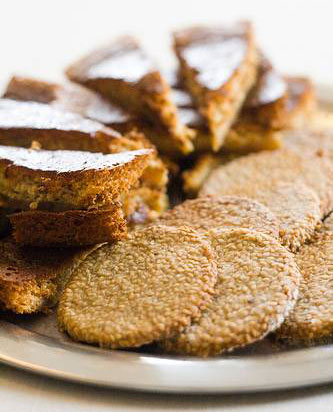
Itrion, mentioned in mentioned in Athenaeus’
The Deipnosophists
“Cakes made of sesame and honey, sweetmeats . . . ”
Much has been written about the ancient Roman diet, but very little attention has been paid to Roman sweets and desserts and even less to their dessert pastries. Yet, Roman pastry chefs appear to have been every bit as advanced as those of the 21st century. Though Roman dessert pastries had to be made without sugar, butter or baking powder, the Roman kitchen included earlier forms of baklava, doughnuts and sponge cake.
While the Romans may have had a sweet tooth, there aren’t many recipes for desserts or pastries handed down to us from history. In multiple sources you sporadically find mentions of biscuits, cakes and dessert, like dishes with fruit or (sweet, soft) cheese of which we know that they were eaten at the end of a meal or as a snack in between meals, sometimes as an appetizer.
The sources for Roman dishes range from pure cookbooks such as Apicius, a Latin collection of recipes from the 4th or 5th century CE, to the Deipnosophistae of Athenaeus, a Greek dialogue from the 3rd century CE that just so happens to take place at a banquet and occasionally touches upon food and drink. Because Greek was the primary language for much of the empire, and many surviving texts for Roman food history were written in Greek rather than Latin, much of what is known today about the Roman kitchen is synonymous with the later Greek kitchen. The names of pastries, cakes and biscuits are often Greek.
Apicius hardly describes any real sweet dishes or desserts that fit our modern definition. We know from other authors, for example Petronius and Martial, that usually sweets were prepared by the pistores, the bakers, a role different from the cooks’. This is probably one of the reasons why the sweets we find in Apicius’ book are simple and quick to prepare, such as the stuffed dates.
Cakes were popular, but without the aid of a leavening agent like baking powder, ancient bakers were forced to use oodles of eggs, which were beaten mercilessly to help the mixture rise! Roman cakes are sometimes collectively referred to as ‘honey cakes’ since the universal use of honey as a sweetener imparted a distinctive flavour. Although butter was not unknown, the Romans preferred to use soft cheeses as a source of fat. The basic dough was a combination of course flour, eggs, honey and/or cheese.
Apicius, the collection of Roman recipes attributed to Marcus Gavius Apicius, a 1st century AD gourmand, includes several recipes for honey cakes, including aliter dulcia, which is prepared by grinding a mixture of pepper, pine nuts, honey, rue (a perennial, evergreen shrub used for flavouring), wine and passum (a sweet raisin wine developed in Carthage). This was then cooked with milk, tracta (a thin pastry crumbled into dishes to add starch) and egg, and served drenched in honey and seasoned with a little pepper (honey and pepper were a common, spicy combination).
There were also sweet buns flavoured with blackcurrants, and spicy wine cakes manufactured from honey, reduced red wine and cinnamon, along with milk puddings laced with honey. The Romans ate a large variety of nuts including walnuts, almonds and pistachios, and these were often used to enhance pastries and puddings in conjunction with honey.
But the ancients’ most enduring contribution to modern cuisine is arguably in the form of a variety of cheesecakes, which may date back as far as the 5th century BC. Aegimus, one of the earliest Greek physicians, is said to have been the first person to write a treatise about the human pulse, and is also supposed to have written a work on the art of making cheesecakes! Cheesecakes feature prominently in De agri cultura, the oldest surviving work of Latin prose authored by Cato the Elder. Estimated to have been written about 160 BC, De agri cultura details rural life and agricultural practices of the time, including the care of vineyards, and was much admired for its simple and direct style. There are a couple of recipes for wine, along with three for traditional Roman cheesecakes.
See Apicius on Dulcia Domestica (homemade sweets)
Ingredients and Tools for Roman Dessert Pastries
The Roman kitchen lacked many of the ingredients today closely associated with pastry making and dessert baking. Many cooks today would be lost without refined sugar, but the Roman baker would not have known what to do with it. He used honey, which lent its flavour to whatever dish he was making.
Nor would the Roman pastry chef have used butter. Butter was known to the Romans, but primarily used as a salve rather than an ingredient in food. Fat in baking would rather have come from a variety of soft cheeses, washed carefully with fresh water to remove the salt in which they were preserved.
Though the Romans were familiar with sourdough they had no easily accessible leavening agent for cakes, such as baking powder, but they could still produce light cakes that rise slightly when baked. The trick was to beat eggs well and use a high egg to flour ratio.
That today indispensable baking tool, the rolling pin, appears to have been unknown in the Roman era and dough was probably stretched by hand. There is, however, some indication in the ancient sources that they had a tool similar to the cookie press.
Roman "Baklava, Sponge Cake, Danishes, Doughnuts and Cookies"
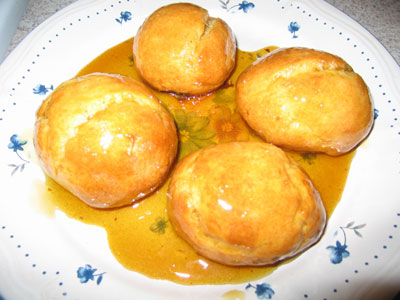
Libum (which literally means ‘cake’ in Latin) was a ritual food prepared as an offering to the gods. The Roman poet Ovid, a contemporary of the older Virgil and Horace, enthuses about a libum infused with clear honey, and traces the origin of these cakes back to the very discovery of honey by Bacchus – also known as the inventor of beekeeping (incidentally, Ovid also mentions the use of birthday cakes).
Cato’s recipe for libum uses a combination of cheese, flour and egg, which is kneaded into a circular shape and then topped with bay leaves before being covered and baked. Once the libum has browned, the bay leaves are removed, and it is served hot (honey may be added to create a sweet rather than savoury version).
Recipe for Libum
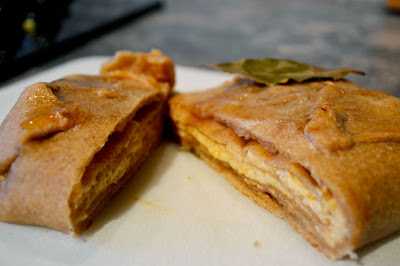
Placenta: The placenta cake from Cato is perhaps most like modern cheesecakes in that it is formed on a crust which is prepared separately. The name derives from the Greek plakous, for flat cakes. Described in the 4th century BC by Antiphanes and Archestratos, both Greek poets, the recipe was adopted by the Romans, and bakers commonly sold slices of this delicacy.
Flour (from emmer wheat) and water were used to make a thinly rolled crust (big enough to wrap all around the cake), which was then covered with layers of a cheese and honey mixture, interspersed with sheets of tracta (thin sheets of pastry, usually dried). The outer crust was then wrapped up around the cake to hold it all together. It was cooked in a testum for about half an hour, and then smothered with more honey. The end result would have been somewhat similar to the baklava so popular in the eastern Mediterranean today. Lots of redactions and interpretations are around.
Recipe for Placenta
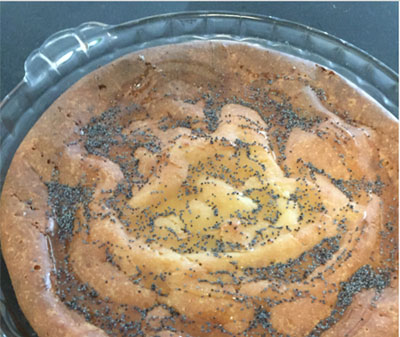
Savillum was an ancient Roman precusor to modern-day cheesecakes made from goat milk and honey, often sprinkled with poppy seeds. It is a completely different, soft, sweet cheesecake eaten as a dessert with a spoon.
The dough is again made from flour, cheese and egg, with the addition of honey; it is important not to add too much flour, so that the cake stays soft. After cooking for about twenty minutes in a testum (a kind of portable earthenware oven, rather like a tagine), the savillum is drenched in honey and sprinkled with white poppy seeds, whereupon it is returned to the testum for a few minutes prior to serving.
Recipe for Savillum
Spira: The sometimes elaborate Danish pastry also has a Roman forerunner. This artistic pastry, known as spira, was made from the same type of dough as the placenta (see above). The bottom layer was coated in honey, but instead of adding layers the chef rolled the dough into a rope with which he created spiral patterns on top of the honey. The interstices were then filled with honey and cheese and sometimes fruit.
77. Recipe for spira: For the quantity desired do everything in proportion just as for the placenta, except that you shape it differently. Cover the tracta on the crust thickly with honey; then draw out like a rope and so place it on the crust, filling it closely with plain tracta. Do everything else as in the case of the placenta, and so bake.
- Cato, De Agri Cultura (On Agriculture)
Enkythoi: The enkythoi or enkithoy was a flat, moulded, spongy cake and was an ancient precursor to the modern sponge cake. It is attributed, in the writings of Athnaeus, to the Lydians in Asia Minor. This simple cake consisted of stiffly beaten eggs, honey and flour.
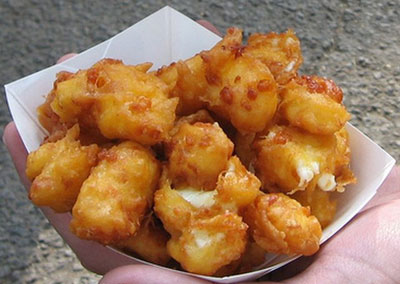
Globi: The doughnut too has ancient Roman precursors. Known as a globi, or globuli, and named for its round shape, it was a pastry made from equal amounts of cheese and flour. The globi was then deep-fried in a bronze dish full of either animal fat or oil, depending on the cook’s preferences, and dipped in honey.
Recipe for Globuli
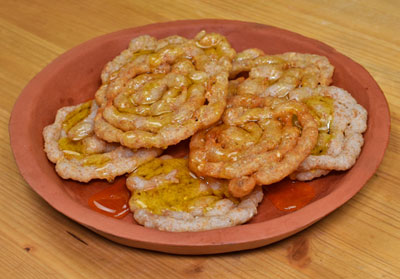
Encyta: A curious derivation from the globi was a fried cookie of sorts, called encyta. It follows the same recipe as the globi, but was pressed through a tube into equal shapes, as if though using a modern cookie press. In this shape, the doughnut-cookie was then fried and served with either honey or a mixture of honey and wine, presumably for dunking or as glazing. [Sounds similar to Funnel Cakes to me.]
80. Make the enyctum [The word is the Greek ἔγχυτον, literally "cast in a mould." Compare Athenaeus 644C] the same way as the globus, except that you use a vessel with a hole in the bottom; press it through this hole into boiling lard, and shape it like the spira, coiling and keeping it in place with two rods. Spread with honey and glaze while moderately warm. Serve with honey or with mulsum [A mixture of boiled must and honey].
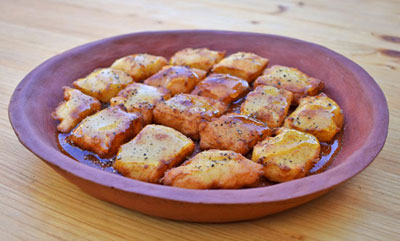
"Delian Sweets" (deep-fried dough pieces covered with honey & pepper)
This sweet is from a chapter of Apicius’ De Re Coquinaria dedicated to the dulcia domestica, which means homemade sweets, probably to distinguish them from others made, instead, by specialized bakers. Apicius lists 10 Dulcia Domestica in this chapter. It is based on a puls prepared with durum wheat flour and milk (or water, as the recipe specifies, but the author recommends milk). The dough is left to cool and is then is cut into squares. The squares are then deep-fried and covered with honey and pepper while still warm.
Delian Sweets recipe
Erneum: Another possibility is 'erneum', also from Cato. Again: fresh cheese, honey, coarse flour (the writer prefers to use semolina) mixed into a dough and put into a mold (Cato suggests a coarseware vessel which is afterwards broken, but you could use a pudding mold). Suspend in boiling water, cook till done, unmold and serve.
Sweet Biscuits: Glykinai, enkrides, itrion: The Romans also had many types of sweet biscuits. Glykinai were biscuits sweetened with wine, enkrides were biscuits fried in olive oil and dipped in honey, and itrion were thin biscuits made from sesame seeds and honey (mentioned in Athenaeus’ The Deipnosophists).
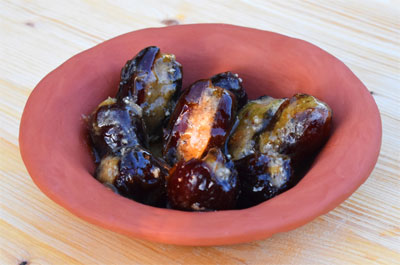
Honeyed Dates: Fresh and dried fruits as well as nuts were popular for serving for the dessert course. This recipe combines dried fruit and nuts by stuffing dates with nuts or nut kernels and ground pepper. The dates are then salted on the top and bottom and fried in honey to coat. The recipe comes from Apicius’ chapter on Dulcia Domestica.
Recipe for Honeyed Dates
Fruit and Honey "Leathers": Galen (Greek physician, surgeon and philosopher in the Roman Empire, AD 129 - c. AD 216) has a tantalizing little mention of a kind of sweet made from boiled quinces and honey. If you just boil, puree and strain quinces and then slow-cook them with an equal weight of honey for a few hours, the mixture will gel and can be cut into pieces.
