Frosting, Icings & Glazes
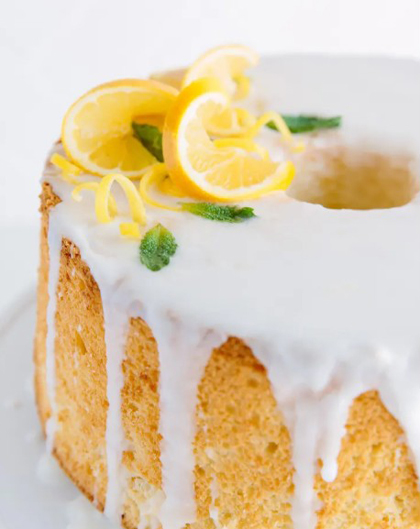
Chiffon Cake with Lemon Icing
Tips for Finishing Cakes
Some cakes come out of the oven, cool, and are good to go. But many benefit from (and some require) "finishing," meaning that they need to be combined with other components to taste and look their best. For many cakes, this means stacking layers on top of each other, sandwiched with a filling. But cakes can also be baked in long, thin sheets and rolled up with a filling. And even cakes without layers are often topped with a glaze or frosting. Finally, lots of cakes are made more beautiful with the addition of edible decorations.
Many cakes use combinations of these techniques—for instance, a syrup and custard between the layers, frosting on the outside, and piped decorations. Some techniques go better with certain types of cake. Mixing and matching various types of cakes and finishing techniques is one of the most creative parts of cake-baking.
Elements used to cover the top and sides of the cake include frosting (a soft substance spread on the cake), icing (can be a synonym for frosting, but also includes rolled icings such as fondant and thinner icings that are similar to glazes), and glaze (a thinner matierial brushed on top of a cake or poured over it while warm and allowed to cool or harden). French and Viennese pastry chefs originally invented the idea of glazing cakes as a way of preserving them—the glaze sealed off the cakes from the air and prevented them from growing stale.
The first key to frosting/icing is choosing one that complements the flavor and texture of the cake. A very light sponge cake, for example, would be overpowered and weighed down by heavy royal icing. On the other hand, a hearty fruit cake would overpower a light whipped cream frosting. Many cooks also choose different frostings to fill layer cakes, or use fruit puree or puddings as fillings.
Before frosting, the cake must be completely cool or the frosting will spread too thin and melt into the cake. Brush loose crumbs from the cake prior to frosting, or consider freezing very soft cakes before frosting, if possible. Another trick is to use a thin layer of frosting called a crumb coat, letting it dry, and then frosting the cake over it.
Also see Cake & Frosting/Topping Combinations
Frostings vs Icings vs Glazes
The simplest way to differentiate between frosting vs icing vs glaze is consistency. Frosting is the thickest of these confections and is ideal for spreading or piping on cakes, cupcakes and cookies, while icings are mostly used for decorations and for light sugary coatings on cookies and donuts. Icing is a little thinner than frosting, is typically made with a base of powdered sugar combined with a liquid like milk, cream, juice or egg whites and is often poured or piped—and it usually hardens when it dries.
Glaze is the thinnest and most fluid of the three, and it will set but won’t harden as much as icing. Typically made with confectioner’s sugar and milk, water or juices, glazes are a thinner form of icing that can be flavored with all kinds of delicious additions and poured over cakes, scones, cookies and more. They form a shiny hard crust when the glaze sets. A glaze is usually drizzled or brushed onto a dessert, primarily used to add a shiny finish and a subtle sweetness without overwhelming the flavor of the baked good; essentially, a glaze is a more delicate, liquid-like topping compared to icing which has a more substantial consistency.
Icings and glazes do not always cover the entire cake. Many times the glaze or icing will only drizzle down the sides of the cake. They are used to garnish bundt style cakes, Angel Food cakes, and other foam or sponge type cakes but a glaze or icing coating also adds moisture and flavor to the cake.
Frostings, icings and glazes are staples in professional and home bakeries.
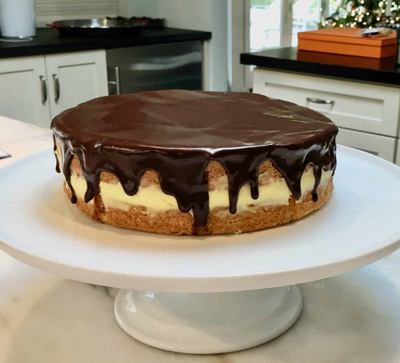
Boston Cream Pie with Chocolate Icing
Icings
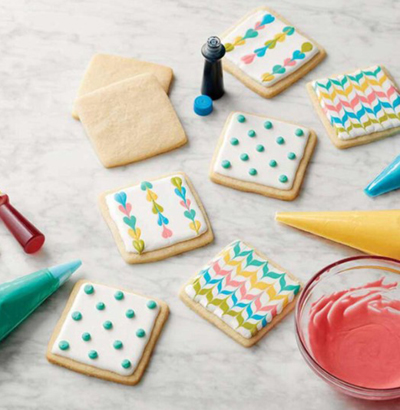
Icing is a pastry topping made with confectioners’ sugar (or powdered sugar) mixed with a liquid, such as milk or cream, lemon juice, or liqueur. Food coloring is added to make colorful, decorative icing, which can be used to decorate frosted cakes. Icing is commonly used to decorate sugar cookies, especially for holiday cookies with colorful decorations. It is also used as the glue to hold gingerbread houses together and to secure candy pieces and decorations to the gingerbread. Use icing for desserts where you want a thin layer of sweetness on top, such as cinnamon rolls, Danish, pound cake, or bundt cake. Icing is generally not spreadable like frosting—it needs to be poured, spooned, or drizzled over baked goods.
Glacé Icing (shiny, semi-hard icing used especially for cookies and other items that will be stacked on top of each other)
Water Icing, also called glacé icing (confectioner's sugar & water or other liquid, excellent simple glaze)
*Mom's Vanilla Icing, also called Confectioner's Decorating Icing (& variations, good on yeast breads and pastries)
*Thin Chocolate Icing (made with unsweetened chocolate, confectioner's sugar, drizzle over chocolate eclairs, cream puffs, Boston Cream Pie, etc.)3 Types of Icing: Icing is simple to make and to flavor. Some types of icing for cookies and cakes include:
Standard icing: Icing is made by mixing powdered sugar with a liquid such as milk or cream, lemon juice, or liqueur. Add melted butter or vanilla extract for added flavor.
Royal Icing: This type of icing combines meringue or whipped egg whites with powdered sugar and water. Some bakers use meringue powder instead of eggs. Royal icing is most commonly used for cookie decorations.
Fondant: This type of icing is made with sugar, water, butter, and gelatin. You can also use marshmallows as a substitute for gelatin. The mixture has a clay consistency, which enables the baker to sculpt it into elaborate shapes, and it dries and completely hardens. Fondant is used to create intricate designs, such as flowers for wedding cakes.
Royal Icing
Royal Icing is a one of the older icings. "Royal icing" type coatings exist in 18th/19th century British & American cookbooks.
Very sweet flavor. Not the first choice for flavor. Royal Icing originated in England, where it was first prepared for special occasions such as weddings, anniversaries, and baptisms. You can make it from scratch, using powdered sugar, egg whites, and liquid, but some prefer using meringue powder, which you can buy at bakery supply stores and even some grocery stores. The meringue powder is combined with a liquid, then usually tinted with food coloring.
The proper consistency for royal icing is about the consistency of pancake batter. It should flow easily since it's usually used in pastry bags with decorating tips. This icing dries to a candy-hard finish and is frequently used for delicate decorations on elaborate wedding cakes, gingerbread houses, or other intricate creations.
Royal icing is great for outlining and flooding sugar cookies, decorating gingerbread houses, adding icing flowers to treats, and other intricate designs. Because this icing hardens as it dries, it’s not usually recommended for cakes and cupcakes. Still, it’s a perfect stiff icing for sugar cookies with its smear-proof finish that will keep your fingers icing-free.
Ganache
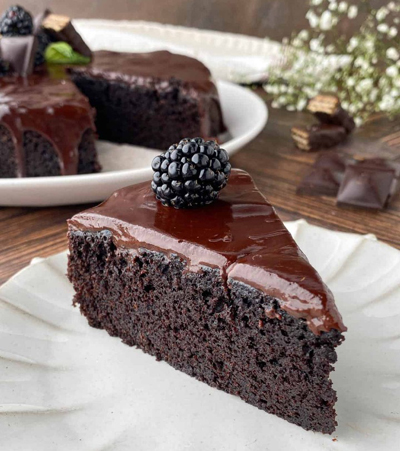
This is a rich mixture of chocolate and cream that can be paired with many different types of cakes. You can change the impact of a ganache by varying the ratio of chocolate to cream —at one-and-a-half parts chocolate to one part cream it makes a thick, luxurious filling for cake layers. If you use equal amounts of chocolate and cream—known as "ordinary ganache," though it tastes pretty extraordinary—the result will be a bit thinner. The more cream you use, the softer your ganache will be. At room temperature, this mixture makes a beautiful shiny glaze on cakes, donuts and cookies.
Ganache is most often poured over a layered cake or bundt cake similar to a glaze to provide a coating to the cake. It is best not to use where it will be exposed to warm temperatures because it will soften. Ganache is technically considered an "icing" rather than a frosting, as it is typically thinner and denser than frosting, usually poured or drizzled over a cake, and sets quickly due to its primary ingredients of chocolate and cream, without the added air whipped into a traditional frosting which makes it lighter and fluffier; however, depending on consistency, ganache can be used as a frosting if whipped to achieve a softer texture. Or, if chilled briefly, it will thicken slightly and can be beaten it until it's fluffy and stiff, then spread on the outside of a cake as a frosting.
Rolled Fondant (used by cake artists)
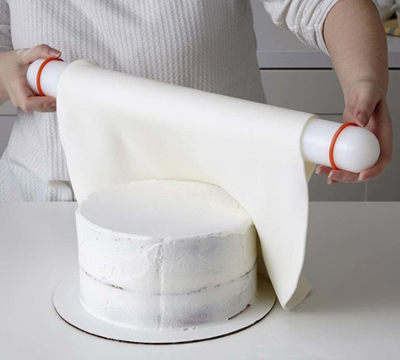
This is a combination of sugar and vegetable shortening that makes a thick white puttylike substance that can be rolled out like pastry dough and stretched over cakes. Rolled fondant is popular among cake artists because it holds up well in hot weather, can be tinted any color, and forms a smooth, perfect surface for decorations. Unfortunately, while it looks terrific, fondant does not have much flavor and, if applied too thickly, can taste terrible.
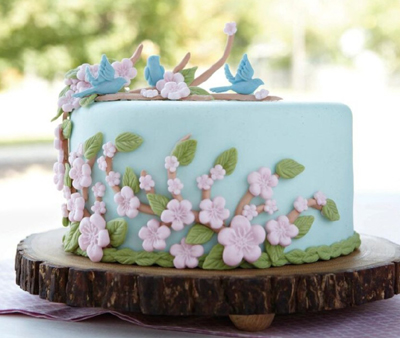
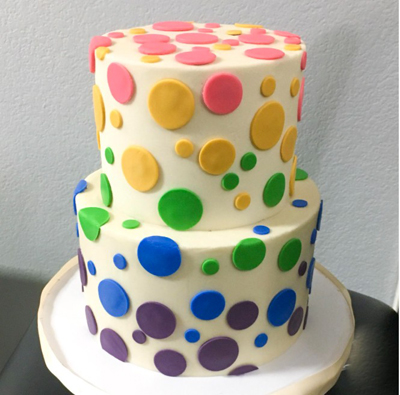
Flavoring is also added to the fondant. The dough is kneaded until it is smooth and pliable. It is then rolled into a thin sheet of icing that is used to cover a firm variety cake. The sheet of fondant is place over the cake so that it will cover all sides and is then smoothed on the top and sides. Generally the cake is first covered with a coating of buttercream frosting, marzipan, or apricot glaze to seal in moisture to help keep the cake fresh before the fondant is place on it. The fondant gives the cake a smooth, elegant, matte finish that is great for wedding cakes. It provides a nice smooth finish that is great for decorating with other frostings. The rolled fondant can also be used to make leaves, flowers, and other designs to apply to the cake.
The most basic difference between buttercream and fondant is that buttercream is a frosting, while fondant is essentially a thicker form of icing. The terms 'frosting' and 'icing' are often used interchangeably, but strictly speaking, they refer to two different things. Fondant is technically considered a type of icing, as it is a sugar-based coating used for decorating cakes, but its texture and consistency are very different from most other icings, often resembling modeling clay, making it more suited for sculpting and detailed decorations rather than just spreading on a cake like a typical frosting.
Glazes
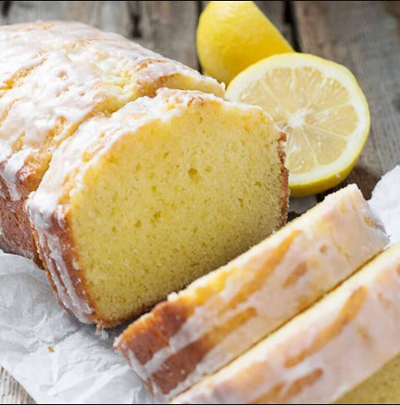
A baked good glaze is a thin, liquidy coating that adds shine and a subtle sweetness to baked goods. Glazes can be brushed or drizzled onto baked goods. Typically made with confectioner’s sugar and milk, water or juices, glazes are a thinner form of icing that can be flavored with all kinds of delicious additions and poured over cakes, scones, cookies and more. Glazes and doughnuts are another winning combination as in glazed doughnuts. Glazes can enhance the appearance and flavor of baked goods without overpowering them.
Simple Sugar Glaze (used to give fruit cakes, etc. a sugary sheen)
Basic Fruit Glaze (made from preserves, for tarts, etc.)
Chocolate Glaze (chocolate mixed with a little butter, for drizzling over chocolate eclairs, cream puffs, Boston Cream Pie, etc.)
Types of Frosting
Frosting can be classified into four types: American buttercream, Traditional or European buttercreams, Cooked Frostings, and Whipped Cream Frosting. If Ganache is whipped until fluffy, it can be used as a Frosting.
Buttercream
Sweet, buttery flavor. Buttercream frostings rely on the main ingredient of butter and will be the most common type of frosting you will find in a bakery. Buttercream sometimes uses eggs to impart a smooth and airy consistency. Buttercream is extremely versatile—it can be used both between the layers and to cover the outside of a cake, and it goes well with both butter/oil cakes and lighter genoise-based layer cakes. It can also be piped to form decorations. Commonly used for sheet cakes and cupcakes.
Buttercream is a blank canvas that can be flavored with virtually anything such as extracts, spices, melted chocolate, jams, and curds. As a general rule of thumb, the flavoring added to the buttercream should not exceed half the weight of the butter in the recipe.
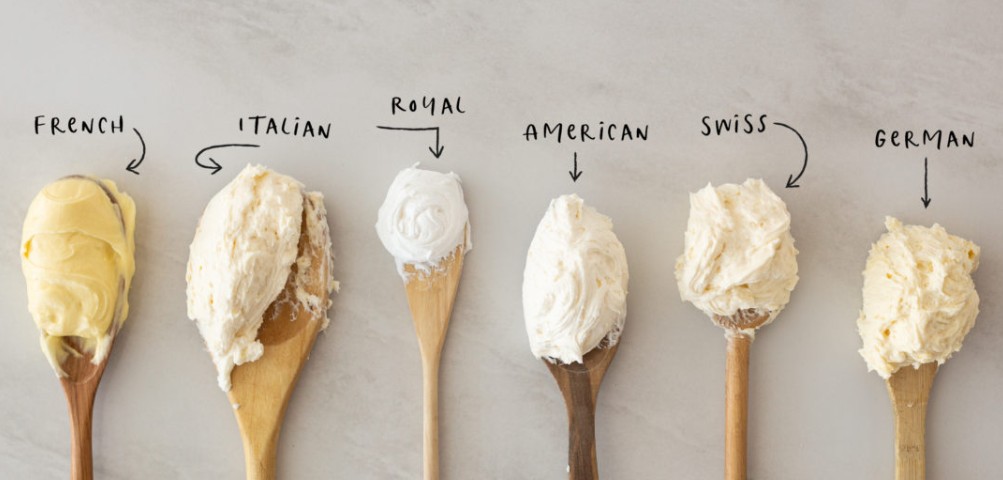
There are a variety of styles of buttercreams all varying in their degree of difficulty to make. Each style of buttercream has different pros and cons as well as best uses in the pastry kitchen. There are three types of buttercreams that are most often used: American Buttercream, Swiss Meringue Buttercream, and Italian Meringue Buttercream. There are a few other types of buttercream that are less commonly used like French Buttercream, German Buttercream, and a very new style of buttercream called G.G. Glossy Buttercream (or Korean Glossy Buttercream). Korean glossy buttercream is exactly the same as Italian meringue buttercream with one small change. The butter in Korean buttercream is cold when it is beaten in. This one change completely changes the texture and look of the final buttercream.
American buttercream, also known as simple buttercream, is the easiest buttercream frosting to make and the one most commonly used in non-professional kitchens. Swiss meringue buttercream, also known simply as Swiss buttercream, is perhaps the buttercream most commonly used in professional pastry kitchens. Italian meringue buttercream, also known simply as Italian buttercream, is the most stable of all of the buttercreams but also the most difficult to make.
Royal Icing shown in the picture is not a buttercream but the author included it for comparison. Royal icing is not used for piping and to frost cakes. The different colors of the buttercreams are due to the ingredients used. French buttercream is made with egg yolks, Italian uses egg whites, American uses no eggs, Swiss uses egg whites, and German uses whole eggs. None of these buttercreams in the picture have any flavoring or colorings added.
You can pipe with pretty much ANY kind of buttercream, whipped cream or ganache to decorate cakes with flowers and other designs. A stiffer buttercream like American Buttercream will be more stable against heat but the petal edges of flowers will be a bit more jagged because of the extra powdered sugar. Another bonus is after they crust, they are harder to damage.
Plain buttercream is also referred to as American buttercream or simple buttercream frosting made without eggs. Simple buttercream is considered a beaten butter frosting (which whips the butter first) as opposed to a cubed butter meringue frosting (which has butter chunks slowly added to the frosting). Butter is combined with powdered sugar, flavorings, and liquid. Powdered sugar is used because it dissolves easily during beating and contains a small amount of cornstarch which helps stabilize the frosting. There are buttercream frostings that use granulated sugar, but these take a long time to make and can be difficult. Note that cream cheese frosting is merely simple buttercream which uses cream cheese instead of butter as the fat.
American Buttercream (Confectioners' Sugar Icing): This is the classic frosting you'll find on old-fashioned birthday cakes. It's often used both as a filling and to cover the outside of the cake, but it's much sweeter than traditional European buttercreams, and may be a bit gritty, so may be best reserved for topping casual cakes and cupcakes. It's very easy to prepare: Butter and confectioner's sugar are simply beaten together, and then the mixture is softened with a little liquid such as milk or fruit juice. It is then whipped in a bowl until thick, smooth and fluffy. Flavorings such as vanilla extract, almond extract, lemon juice and chocolate can also be added.
The method for making American buttercream, also known as quick buttercream, involves mixing confectioners' sugar (aka powdered sugar or icing sugar) with butter and sometimes milk or heavy cream—no heat, no eggs. Some pastry chefs don't consider this type of frosting buttercream since it is not as creamy as European buttercreams.
It’s the sturdiest option for writing on a cake.
Cream cheese frosting is a type of American buttercream involves whipping room-temperature butter and cream cheese together and adding powdered sugar. Cream cheese buttercream, a rich variant on buttercream frosting, is the classic pairing for American butter cakes such as red velvet and carrot cakes.
Buttercream Frosting (variations: chocolate, coffee, mocha, citrus)
Chocolate Frosting
White Chocolate Frosting
Creamy Mocha Fudge Topping
*Cream Cheese Frosting
Chocolate Cream Cheese Frosting
Mascarpone Frosting
Peanut Butter Icing
Traditional, or European, buttercream usually involves making a meringue or custard, then beating butter into it until a frosting consistency is reached. Some prefer simple buttercream frostings, beating softened butter with powdered sugar, liquids and flavorings. Beat the frosting longer than you think is necessary for the smoothest and fluffiest results. It's really not possible to overbeat this type of frosting.
Traditional Buttercreams: Traditional buttercream (as opposed to American Buttercream) starts with a base of eggs and sugar, then soft butter is beaten in. To finish, flavorings are added—these can include vanilla extract, coffee, chocolate, lemon juice, or fruit purées and curds. There are four traditional types of buttercream—two called "meringue" varieties, because they use only egg whites, one that uses yolks, and one that uses whole eggs:
Meringue-base Buttercream: There are two technical methods of creating meringue buttercream - the Swiss method and the Italian method. This frosting is used for wedding cakes to achieve a perfectly white coating
Swiss buttercream starts with making a meringue. Swiss Meringue Buttercream is made by heating egg whites, sugar and an acid (cream of tartar) in a bain marie (waterbath) until the sugar is dissolved. It is then transferred into the mixer and whipped until a stiff foam forms and a temperature of 160 degrees F is reached. This takes 2 to 4 minutes, where the egg whites are considered "cooked". It is then beaten with butter to make a buttercream meringue. Swiss meringue buttercream is relatively quick to make and yields impressive results. Swiss meringue buttercream is known for its silky, light and creamy texture without being too sweet.
This type of buttercream is the simplest to make and is probably the best for most situations. The result is always a beautiful, white buttercream that you can get really smooth on a cake. In warm weather, it doesn't hold up as well as Italian Meringue Buttercream does, but you can make it with hi-ratio shortening so it will be more stable in temperatures over 80 degrees F. Shortening's melting point is about 98 - 110 degrees F. Butter begins to melt at 85 degrees F. Stick margarine's melting point is close to butter's, although a little higher.
Good for: Piping and frosting; also for bakers who are intimidated by boiling sugar syrup (although you still need some time at the stove)
Italian Meringue Buttercream. Italian meringue buttercream is identical in consistency and texture to Swiss meringue buttercream. However, the meringue is created using sugar syrup. The difference lies in how the ingredients are combined. For Italian meringue, sugar syrup is boiled until it reaches 245 degrees, then added to egg whites while they're whipping. Once whipped, softened butter is added to the bowl, a little at a time and whip until a fluffy consistency is reached. You can make the icing in advance; keep it in an airtight container in the refrigerator for a week.
The process is a bit complicated—the mixer must be running when the syrup is added or the hot syrup will cook and harden bits of egg. Italian meringue buttercream is not practical to make in small quantities, because there's so little sugar syrup that it's difficult to get an accurate thermometer reading. However, for large batches, some professionals prefer it to Swiss meringue because only the syrup needs to be heated, not the eggs.
This is more popular than Swiss Meringue Buttercream. Italian Buttercream is a staple in the cake baking industry because it is less prone to melting than Swiss Buttercream in warmer climates. Its smooth finish is perfect for decorating birthday cakes, wedding cakes, and pies, especially for outdoor events. This buttercream is considered to be the most difficult of the meringue buttercreams because of its need for accurate measurements, temperatures, and mixing speeds.
Good for: Piping any kind of shape, roses, or decorations
French buttercream uses only egg yolks and is made the same way as Italian meringue. This type of buttercream is the richest of buttercreams. Some people like the rich flavor, but others find it too overwhelming. Due to the egg yolks, this buttercream is very perishable and should be kept refrigerated. This buttercream is soft, does not hold its shape very well and will melt in warm conditions. Because of its soft consistency, this frosting is mainly used for fillings, cupcake frosting, and the base for fruit tarts.
This buttercream is more difficult to make. The method for making it calls for the egg yolks and sugar syrup to be whisked together. Then butter and extracts are added to create the buttercream. The sugar temperature needs to be monitored closely so it doesn't get too hot and crystalize.
Good for: Piping decorations; frosting whole cakes; filling macarons
German Buttercream, also known as Pastry-Cream Buttercream or creme mousseline, is a beaten butter frosting and can also be referred to as custard buttercream or pastry-cream butter. German buttercream is known for its creamy texture without being too sweet.
The unique recipe is rare in the bakery scene but can be a great change of pace over a traditional buttercream. It is soft and pipable, but not very stable and will melt in warmer conditions. To make German buttercream, you will first need to make the rich pastry cream or custard that serves as the base of the frosting. This recipe uses whole eggs, unlike most buttercream recipes which usually just use the whites or yolks. Once the custard is made and has cooled, it is gradually added to beaten butter and whipped until light and fluffy.
Good for: Layering with dense, nut-based cake for tortes, filling a cake, piping on top of cupcakes
Whole-egg buttercream is also made with sugar syrup, like Italian meringue. It's richer than the meringue varieties, but not quite as rich as French buttercream which uses just egg yolks. It's also quite perishable and should be refrigerated.
Decorator's Buttercream: Because butter tends to melt at room temperature (or at least become very soft), buttercream frosting is not ideal for producing the decorative flowers and curlicues you see on fancy wedding cakes. The solution is to so-called decorator's buttercream, which—instead of butter—is made with vegetable shortening. In addition, decorator's buttercream is whipped considerably less than ordinary buttercream. What it lacks in lightness, it makes up for in stability, making it ideal for producing those decorative flourishes. Unfortunately, it lacks flavor, so it's not uncommon for a small amount of butter to be included.
Cooked Frostings
A Cooked or Boiled frosting is a white fluffy topping that is made without any type of fat added. Most of its ingredients are cooked until they come to a boil and are then boiled for a period of time. The boiled mixture is then slowly mixed into beaten egg whites until the icing is light and fluffy. Some boiled frosting recipes are a little sticky and set up fairly quickly so they need to be spread as soon as the frosting is made, while others will remain workable without having to worry about it setting up.
It is mostly used in cake decorating as an overall frosting layer that can be spread smoothly over the surface of the cake or it can be given a simple frosting design such as swirls or peaks. It can be used for some basic piping, such as borders or writing but, because it is so light and fluffy and can be slightly sticky, it is a little harder to work with when decorating a cake or cupcakes.
It is best if used as soon as it is made but if necessary it could be stored for a day. Be sure to cover tightly and then refrigerate. If it is not stored airtight, it will begin to set. Once a cake has been frosted with boiled icing it can be stored at room temperature but refrigerating will help keep the frosting soft and fluffy longer. Freezing is not recommended.
Seven Minute FrostingSeven-Minute Frosting (Fluffy White Icing, Italian Meringue Boiled Frosting) is the classic cooked frosting and is a pure white and marshmallowy. Although 7 Minute Frosting is in the tradition of European meringue frosting, the recipe first appeared in the 1912 edition of the Fannie Farmer Cookbook, published by the Boston Cooking School. It's often used on cakes and cupcakes.
Egg whites and granulated sugar, along with flavorings, are combined in the top of a double boiler. The mixture is gently heated while continuously beating with a mixer until it's fluffy and glossy. (In the days before electric mixers, it was beaten with a rotary beater for seven minutes, hence the name.) As the mixture cooks, a meringue forms, which is stabilized as it grows because it is being heated. Cooked frostings hold their shape because the egg white proteins have been coagulated by the heat. These frostings are fluffy and delicate and can be absorbed into the cake if not eaten the first day. They are 100% fat free because made from egg whites.
Fluffy white icing is most commonly used both between layers and to cover a traditional coconut cake or a devil's food cake—the contrast between the dark cake and the white frosting makes an appealing statement. This frosting is not as common these days, but it used to be wildly popular for many types of layer cakes, sometimes only as a topping, with jam used as the filling. Substituting light brown sugar for granulated sugar makes sea-foam frosting, an old-fashioned recipe that deserves a revival.
This sets quickly, so be ready to take it from bowl to cake to finished look right away.
Ermine buttercream is commonly referred to as flour buttercream, roux frosting, cooked frosting, or boiled-milk icing. It first became popular in the late 1800s as the icing of choice for mahogany cake, an early version of red velvet. Ermine frosting is a beaten butter frosting made by cooking flour and sugar with milk to make a sweet paste. This paste is then whipped into softened butter until light and fluffy. The classic style of this buttercream uses all-purpose flour and tastes like a very light vanilla pudding. Many people liken it to whipped cream. Vanilla and salt is added for flavoring.
Ermine Buttercream combines a sweetened flour paste with whipped butter, giving it a unique, delicious flavor and light texture. The stability of the flour paste allows us to use less butter than other buttercreams, which is likely why many compare this frosting to whipped cream. It also uses less sugar and is ideal for those who need the stability of a buttercream but dislike the heaviness and sweetness of other frostings.
Most consumers have not heard of Ermine buttercream, but are familiar with it, as it is usually found in pre-packaged supermarket pastries, such as Twinkies. Ermine frosting usually serves as an eggless alternative to Swiss meringue buttercream.
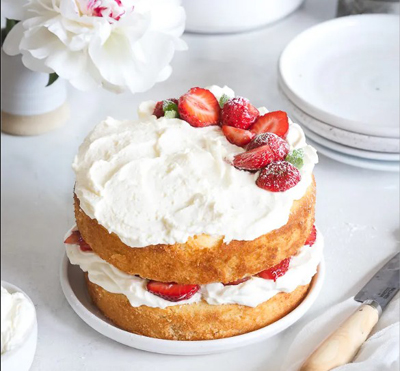
Whipped Cream Frostings
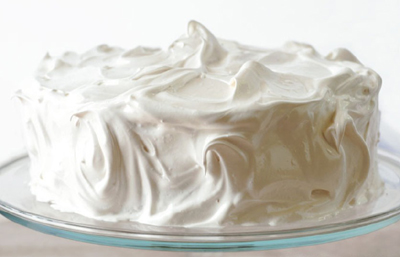
Powdered sugar, flavorings, and whipped cream make whipped cream frostings - what could be simpler? Again, the cornstarch in the powdered sugar helps stabilize the frosting. Whipped cream frosting is made by whipping heavy cream until it's fluffy and adding powdered sugar. Whipped cream is not very sweet, so it’s commonly used on desserts that are already quite sweet, such as cheesecake or ice cream. Many people like it on a strawberry shortcake cake, as in the picture. It can also cover the entire cake.
It is possible to overbeat this type of frosting, so just beat until firm peaks appear when you stop beating and lift the beater straight up from the frosting. Cakes, cupcakes, and cookies with this type of frosting must be refrigerated.
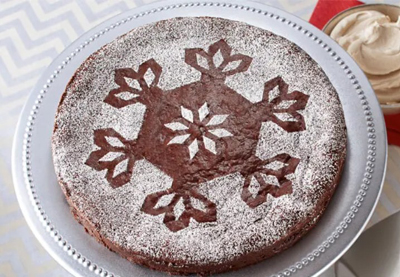
Dusting
Dusting is generally a coating of powdered sugar or cocoa powder that is applied to a cake or cupcakes after they have cooled. It can also be applied over the frosting for certain effects. A light dusting can be applied by using a sifter, sieve, or dredger. The coating is sometimes applied as an all over dusting and sometimes a stencil is used to create a design. Other ingredients that can be used for dusting include: cinnamon; cinnamon and sugar; colored sugar; and finely chopped nuts.
Dusting can be used on any type of cake that you do not want to frost. It is also used on cupcakes and brownies. Some people consider frosting too sweet and would prefer their cake without frosting. Dusting is a good method to use to decorate the cake without adding much sweetness. It is also a good technique to use as an additional effect to frosted cakes. Use powdered sugar on chocolate or dark colored cakes, cupcakes, and brownies. Use cocoa powder or cinnamon on lighter colored cakes for the most dramatic effect.
A simple dusting adds a nice flavor and look, but you can get creative with stencils and other objects to make decorative designs. People have used noodles, graters, and other items found in the kitchen, even strips of paper to create strips.
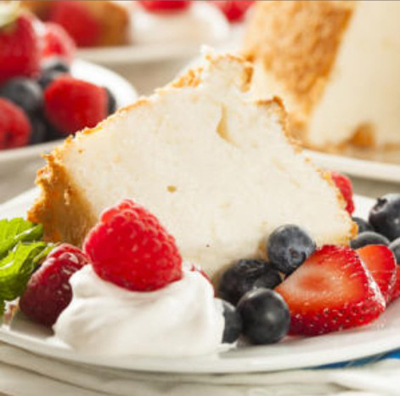
Fresh Fruit
Fresh fruit can also be added as a topping to the cake. A cake with fresh fruit topping should only be assembled within a few hours of eating it. The fruit continues to ripen even when refrigerated and its juices will begin to soak into the cake.
Fresh fruit is used to add lots of flavor and color to a cake. Fruits, such as strawberries, raspberries, blueberries, peaches, and kiwi all add a lot of great flavor; they also add a lot of color, each on their own or combined together for multiple colors. It is a natural topping for Angel Food Cake.
Marzipan
This almond paste is another thick material that can be rolled out and used to cover cakes. It's quite sweet and is off-white, so it's not a good candidate for tinting, but it has a much better flavor than fondant. Vienna's famous rum-soaked Punschtorte conceals a paper-thin layer of marzipan under a sugar icing. Marzipan can also be used to mold flowers and other decorations that are then placed on a cake.
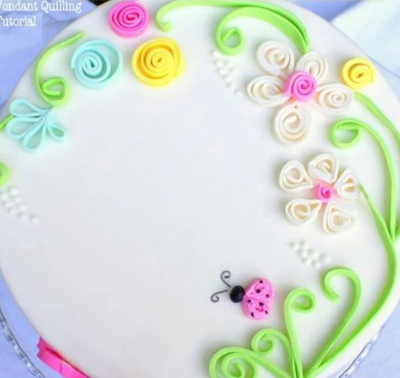
Gum paste strips rolled up and shaped into designs
Gum Paste - Sugar Paste
Gum paste and sugar paste are basically the same product. It is made from sugar dough that generally contains a gum agent, such as gum tragacanth. It has the texture of molding clay and works great for making flowers and other delicate designs. It is stronger than fondant and easier to work with. It can be rolled out very thin and used to make very intricate designs. When it dries it is hard and can be stored for a long time. The decorations made from gum paste are edible but not very tasty.
It is easy to mold and work with to make delicate flowers, figures, animals, ribbons bows, and so much more. But you do not need to create intricate shapes for decorating by hand. You could also simply roll the sugar paste out and use cookie cutters to cut out shapes to lay flat on a frosted cake. There are also a lot of molds that can be used to create different shapes (flowers, sea shells, animals, designs, etc.) Simple and easy.
The paste can be rolled out very thin and it remains still very workable. The shapes can be created by hand on a separate surface, dried, and then placed on the cake or cupcakes. This is helpful when you have a lot of decorations that need to be made because you can begin making them ahead of time and apply them when you are ready to finish decorating.
Decorations
Many cakes are decorated by piping or molding decorations on top of the frosting, and many mediums used to fill and frost a cake can also be used to decorate. Whatever you use, it must be stiff enough to pipe through a pastry bag or mold into a desired shape. In addition to the options listed above, here are two other popular decorating mediums:
- Royal Icing: This is made from a heavy paste of egg whites and confectioners' sugar beaten with a little vinegar or strained lemon juice to help the egg whites froth. The result is a pure-white, sticky icing that dries to a hard finish. Royal icing is used for delicate piping such as elaborate "string" decorations that are piped from a tiny plain tube or paper cone. Its pure-white color makes it a good option for tinting. Its flavor is sweet and unobtrusive, but due to its crisp texture when dry, it should not be used in large amounts.
- Melted Chocolate: This can be piped from a paper cone to write on a cake, or drizzled in a simple decoration. Dark chocolate looks particularly nice against a lighter-colored frosting.
