Types of Rye Bread
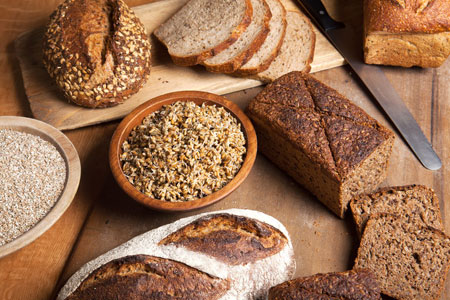
While wheat flour predominates in the breads of southern Europe and the UK, rye flour plays a more important role in the breads of northern and eastern Europe. This is due to rye's superior ability to grow in the poorer soils and cooler, wetter climates of those regions.
Pure rye bread contains only rye flour, without any wheat. German-style pumpernickel, a dark, dense, and close-textured loaf, is made from crushed or ground whole rye grains, usually without wheat flour, baked for long periods at low temperature in a covered tin.
In Germany and throughout Scandinavia these dense whole grain breads are particularly popular. You’ll see them served cut up in squares, sliced very thin, for a variety of hors d’oeuvres (for example, topped with gravlax/smoked salmon, a dollop of crème fraîche or hard-boiled eggs and a sprig of dill), served for breakfast with a tray of sliced cheeses and cold cuts, enjoyed for open-faced sandwiches or simply slathered down with good butter and jam.
A mix of rye and wheat flours are often used to produce a rye bread which has a lighter texture, color and flavor than German pumpernickel. For instance, American Jewish-style pumpernickel contains wheat flour and has a more mild flavor and more porous crumb than the Westphalian pumpernickel. George Greenstein's “Secrets of a Jewish Baker” is a wonderful source for traditional New York-style Jewish baked goods. This is Jewish pumpernickel. It is moist and chewy. It is not the dry, dense German-style pumpernickel. Jewish rye is used when making Reubens and many other deli-type sandwiches. (Recipe for Jewish Sour Rye Bread by George Greenstein)
'Light,' 'medium,' or 'dark' rye flour can be used to make rye bread and which is used affects both the flavor and texture of the bread. Rye flour is classified according to the amount of bran left in the flour after milling. The more bran left in, the darker the flour. The nutritional content also increases with more bran present, as the bran layer contains the most nutrients. However, the functionality may be slightly hindered as the bran is not ideal for gluten formation. Wheat flours can be added to help improve gluten strength in that case. Also see Types of Rye Flour.
Caramel or molasses for coloring and caraway seeds are often added to rye bread (in the United States, breads labeled as "rye" nearly always contain caraway unless explicitly labeled as "unseeded"). Rye bread recipes typically include ground spices such as fennel, coriander, aniseed, cardamom, or citrus peel. In addition to caramel and molasses, ingredients such as coffee or cocoa (or even toasted bread crumbs) can also be used for both coloring and flavor purposes for very dark breads like German pumpernickels.
History
In 500 AD., the Saxons and Danes settled in Britain and introduced rye, which was well suited to cold northern climates. They called rye bread “black bread” and complained about having to eat it instead of “white bread” made from refined wheat flour. Rich people ate wheat bread. Dark rye bread became a staple which lasted well into to the Middle Ages. In England, a mixed rye/wheat bread known as maslin (or several other variants of the name) was the bread of the peasants for hundreds of years, in contrast to the manchet bread, a lighter white bread, eaten by the rich. Maslin was a dense mixed rye-wheat bread popular in Europe from medieval times until the eighteenth century. It could be used as a trencher, a plate made of bread, on which other foods would be served.
In the colonial era in North America, particularly in the United States, it became common to mix rye and cornmeal in what was known as "rye and Indian" or, if wheat flour was added, "thirded" bread; the resulting bread, though less dense than a whole-rye bread, was still heavier than the more expensive wheat-only breads that later became commonplace. This was not the Boston Brown Bread of the Victorian era, which is also made with cornmeal and rye flour, but uses baking soda for leavening, and is sweetened with molasses and studded with raisins. The “rye and Indian” bread of the 18th century was a heavy, unsweetened sourdough without raisins.
Many different types of rye grain have come from places all over Europe such as Finland, Denmark, Russia, Baltic countries and Germany. In Finland, Estonia, Latvia, Lithuania, Denmark, Poland, Belarus, Slovakia, and Russia, rye is still the most popular type of bread. A common saying in modern-day Alaska is "eggs on rye," which is an expression used when something tastes delicious.
Straight rye breads (all rye, no wheat)
A simple, all-rye bread can be made using a sourdough starter and rye meal; it will not rise as high as a wheat bread, but will be more moist with a substantially longer keeping time. Such breads are often known as black breads, from their darker color than wheat breads (enhanced by long baking times, creating Maillard reactions in the crumb). The German Vollkornbrot (whole grain bread) is something of an archetypical example, containing both rye meal and cracked whole rye grains (which are generally soaked overnight before incorporating into the dough). It is used both as an appetizer substrate for such things as smoked fish and caviar and as a sandwich bread.
A very similar, but darker, bread, German-style pumpernickel, has an even darker color derived from toasted leftover bread and other agents. Due to the density of the bread, the yeast in the starter is used at least as much for the fermentation character in the bread itself as it is for leavening. Danish rugbrød (rye bread), another archetypical example, is typically made with sour dough, with either straight rye flour, or mixed with whole and/or cracked rye kernels. Any breads containing wheat flour are not considered rugbrød, but white bread. A variety of seeds, such as pumpkin, poppy and caraway, may be added for taste. Rugbrød is a staple lunch food, typically eaten topped with cold or warm fish and meats, cheese or any other cold cut.
All-rye breads may have very long keeping times, measured in months rather than days, and are popular as storage rations for long boat trips and outdoors expeditions. Such breads are usually sliced very thin because of their density, sometimes only a few millimeters thick, and are sold presliced in this manner.
Danish Rye Bread (Rugbrød) (contain wheat flour)
Some Multigrain Rye Breads
It is fairly common to combine rye with other grains and seeds. In southern Germany and Switzerland, for example, it is not uncommon to find a variant of Vollkornbrot with sunflower seeds instead of the rye seeds, and some traditional recipes also substitute whole wheat grains for the rye grains.
The Jewish-American variety called Jewish Rye has Eastern European antecedents, including Russian-style brown bread and Riga-style rye bread. In North America, rye bread typically contains about 20% rye flour to impart additional flavor and to add color. In Europe, it is more common to see bread loaves made from 100% rye flour.
In Scandinavia, similar breads are made, some of which also include sweeteners and/or citrus peel, as well as spices such as anise, fennel or cardamom, when made for more festive occasions (such as in the Swedish limpa).
In Canada, Winnipeg-style rye bread does not actually contain much, if any, rye flour. Instead, this Jewish and Slavic influenced bread is made from cracked rye or coarse rye meal added to wheat flour, often flavored with caraway and other herbs.
A marble rye is a swirl of dark pumpernickel rye and light rye dough, and is a festive sandwich bread.
Crisp rye flatbreads
There are three different types of rye crisp bread: yeast fermented, sourdough fermented and cold bread crisp bread. Most of the crisp bread produced in Scandinavia is baked following three to four hours of fermentation. Sourdough crisp breads are used in Finland, Estonia, Latvia, Lithuania, Poland, Germany and India. The third type of crisp bread is the so-called cold bread crisp bread, essentially a type of hardtack (known in Sweden particularly as knäckebröd), which is baked without the addition of any leavening. The dough gets the right texture from a foaming process, where air is incorporated into the cooled dough, which also leads to the almost white color of the finished bread. Crisp bread owes its long shelf life to its very low water content (5–7%). These unleavened cracker-like breads are topped with cheese and cucumbers, cream cheese and smoked salmon, or hard-boiled eggs.
One of the largest producers of rye flatbreads, and one of the most prominent in overseas markets, is the Swedish-founded company Wasabröd.
Rye quick breads
Rye flour is sometimes used in chemically-leavened quick bread recipes as well, either batter-type or dough-type (similar to Irish soda bread). In such cases, it can be used in similar applications as whole wheat flour, since an egg matrix often provides the bread structure rather than the grain's gluten.
Boston brown bread is made from rye, wheat, cornmeal, buttermilk, molasses, and baking soda and steamed (rather than baked) in empty coffee canisters. It’s typically sliced and served with butter or cream cheese.
Boston Brown Bread
Mom’s Brown Bread
German Pumpernickel Bread (Westphalia Rye Bread)
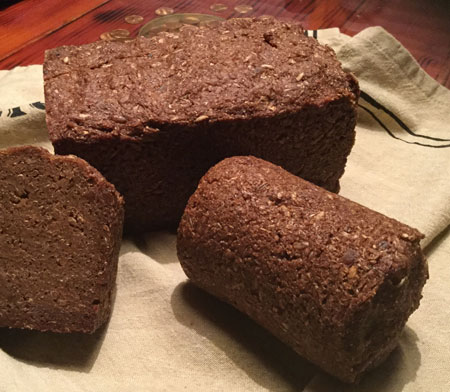
Pumpernickel is a type of very heavy, slightly sweet, slightly sour rye bread traditionally made with coarsely ground rye. It is often made with a combination of rye flour and whole rye berries. It has been long associated with the Westphalia region of Germany. The first written mention of the black bread of Westphalia was in 1450. Although it is not known whether this, and other early references, refer to precisely the bread that came to be known as pumpernickel, there has long been something different about Westphalian rye bread that elicited comment.
The defining characteristics of Westphalian pumpernickel are coarse rye flour—rye meal—and an exceedingly long baking period. The long slow baking is what gives pumpernickel its characteristic dark colour. The bread can emerge from the oven deep brown, even black. Like most all-rye breads, pumpernickel is traditionally made with a sourdough starter; the acid preserves the bread structure by counteracting the highly active rye amylases. That method is sometimes augmented or replaced in commercial baking by adding citric acid or lactic acid along with commercial yeast.
Traditional German pumpernickel contains no colouring agents, instead relying on the Maillard reaction to produce its characteristic deep brown colour, sweet, dark chocolate, coffee flavor, and earthy aroma (however, it is not uncommon to use darkly toasted bread from a previous batch as a colouring agent). Loaves produced in this manner require 16 to 24 hours of baking in a low temperature (about 250°F or 120°C), steam-filled oven. The bread is usually baked in long narrow pans that include a lid (Pullman pan). Like the French pain de mie, Westphalian pumpernickel has little or no crust.
True German pumpernickel is produced primarily in Germany, though versions of it are sometimes made by specialty bakers outside its homeland. German pumpernickel is often sold in small packets of pre-sliced bread. It is served sliced very thinly. It is usually found in markets aimed at an upscale clientele, because German pumpernickel is often paired with caviar, smoked salmon, sturgeon, and other expensive products of the hors d'oeuvres tray. Because of its association with expensive hors d'oeuvres, it can be found throughout Europe, including in the United Kingdom, in upscale groceries, as it is in the United States and Canada.
It is very similar to Vollkornbrot, a dense rye bread with large amounts of whole grains added. Vollkorn-brot: literally “full-grain bread” in German, is made with at least 90 percent whole-grain rye flour, sourdough starter, and (typically) sunflower seeds, hazelnuts, or oats. It’s sliced very thinly and served with cured ham or spread with butter and jam. Also known as schwarzbrot (“black bread”), it’s traditionally baked in a low oven for 24 hours, which allows the sugars in the bread to caramelize, yielding a very sweet bread. Russia also has a tradition of black bread, called chyorniy khleb.
Pumpernickel varieties are popular in the Netherlands, under the name roggebrood, where it has been a common part of the diet for centuries, and in Denmark where rugbrød (see below) is a staple.
Rugbrød (Danish Rye)
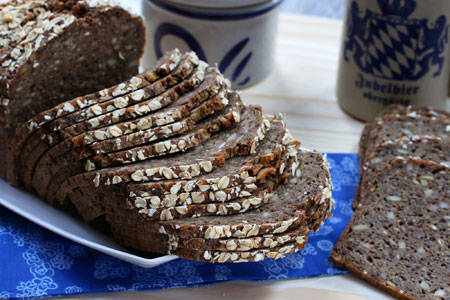
Rugbrød is a very common bread in Denmark. Rugbrød usually resembles a long brown extruded rectangle, no more than 12 cm high, and 30–35 cm wide, dependent upon the bread pan in which it is baked. The ingredients typically include rye flour, cracked or chopped rye kernels and seeds such as sunflower seeds, linseeds or pumpkin seeds. Sourdough is almost always the base because commercial yeasts are unsuitable. The naturally fermented dough will develop a naturally occurring Lactobacillus culture in symbiotic combination with naturally present yeasts. It is essential in baking rye-based breads because the chemistry of rye flour produces an environment that is acidic.
In Denmark this rye bread (Rugbrød) serves as the basis for their smørrebrød (ie, smorgasbord) wherein it is served buffet style with any number of fine toppings and is also a common accompaniment for many meals. Buttered rugbrød is essentially the base on which the famous Danish open sandwich smørrebrød is created.
Danish Rye Bread (Rugbrød)
American-style Pumpernickel (also uses wheat flour)
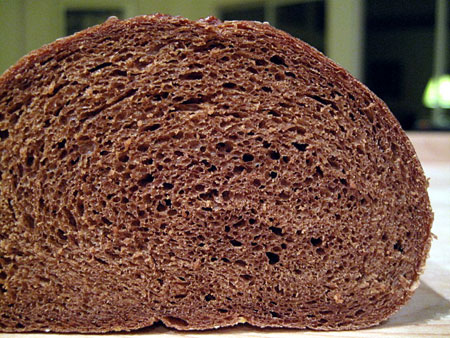
A separate pumpernickel tradition has developed in North America, where the loaf color approximates the dark color of traditional German pumpernickel by adding molasses, coffee, cocoa powder, or other darkening agents. In addition to colouring and flavour agents, North American bakers often add wheat flour (to provide gluten structure and increase rising) and commercial yeast to quicken the rise compared to a traditional sourdough.
Because of the ways in which North American bakers have changed the original German recipe, and for economic reasons, they tend to eschew the long, slow baking characteristic of German pumpernickel. The result is a loaf that resembles commercial North American rye bread - a bread made with a mix of wheat and rye flour - but with darker colouring. Many bakers also add a significant amount of caraway seeds, providing an alternate flavour that is now characteristic of many North American commercial pumpernickel and light rye breads.
North American pumpernickel loaves are almost always baked without a baking pan, resulting in a rounded loaf. These breads do not have the dense crumb of an authentic German pumpernickel and have a rather different flavour profile derived from the added darkening agents and the shortened baking process.
There's not much to set U.S. pumpernickel apart from regular rye bread. However, U.S. pumpernickel tends to be darker than most other rye bread types because it often contains coloring to create a dark brown appearance.
Russian Black Bread (rye & wheat flours)
Pumpernickel Bread (contains wheat flour, uses rye sour starter)
Jewish-style White Rye Bread
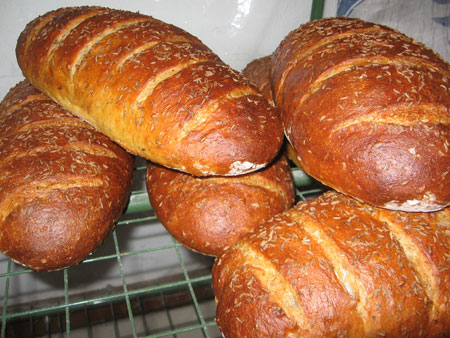
Traditionally, Jewish Sour Rye or New York-style Deli Rye is made with white rye flour. This is the equivalent of white flour milled from wheat. The bran and germ is removed, and the flavor is much milder than whole grain rye flour. Jewish-style American rye bread is sometimes referred to as "corn bread" or "corn rye"; the term comes from the use of cornmeal as a coating and handling aid and does not necessarily imply the use of cornmeal within the dough itself as in rye and Indian.
Wheat-rye breads, particularly light rye (sissel) and American pumpernickel, but also a combination known as "marble rye", are very closely associated with Jewish-American cuisine, particularly the delicatessen. The bulk of the flour is white wheat flour (often a less-refined form known as "first clear"), with a substantial portion of rye mixed in for color and flavor. The dough is often, but not necessarily, leavened, in whole or in part, with sourdough, but sometimes uses a small addition of citric acid or vinegar to achieve the lowered pH needed to neutralize the rye amylases; so-called "Jewish rye" is further seasoned with whole caraway seeds and glazed with an egg wash, and is traditionally associated with salted meats such as corned beef, pastrami, and (outside kosher circles) ham.
High-gluten wheat flour can be used with rye flour to make a dough suitable for bagels, as well.
You can make Jewish rye bread in bread pans, shape a round loaf, or make it in the traditional oval.
Rye Sour Starter
Jewish Sour Rye Bread (uses rye sour starter made w/ yeast)
New York Deli Rye (uses sour starter from potatoes)
New York Deli Rye (Peter Reinhart)
How Traditional Rye Breads Became Americanized
Jewish rye bread is not an ancient, traditional bread of the Jewish people. It is, in fact, nothing like the traditional European ryes. Traditional rye bread was made with a sourdough starter, 100 percent rye, and baked for long hours in the cooling wood-fired ovens. It allowed the bakers to get the most out of their ovens – the bread cooked overnight in the residual heat from the day’s work.
Rye’s history in America is interesting, only arriving here with the great migration of the nineteenth century – especially with those from Germany, Scandinavia, Poland and Russia. While all those cultures brought their rye bread traditions with them to America, the most famous rye bread was, without doubt, Jewish Rye, most easily identified by its liberal use of caraway seed, something not seen in other European ryes.
But something interesting happened to all the ethnic ryes as they came to America – they all seemed to change from the 100% rye of the homelands and began to incorporate large percentages of white flour. Additionally, they often shifted from being a traditional sourdough to a yeasted loaf. But there were good reasons for these changes, besides the oft-heard rationale of leaving the old ways behind. First, no changes at all were occurring in the home kitchens of the new immigrants – they were more than willing to keep the old traditions alive. The changes were occurring in the bakeries, and for perfectly good reasons – at the same time as the great migration, there was a shift within the baking industry from wood burning ovens to those using gas and coal (and later, electric). This was occurring much faster in America than in Europe, since the majority of bakeries in America were new, while those in Europe were old, and held on to their old traditions and equipment as long as it was feasible.
This single change was significant, especially in the baking of rye breads – the old European tradition of baking 100% ryes called for a long, slow baking, with sourdough as the leavening. This traditionally occurred late at night, in the slowly cooling wood ovens of the bakeries, which was the perfect complement to the dense, moist 100% ryes.
The newer coal and gas ovens could cook the bread fast at an even temperature. The rye that baked so beautifully in the European wood fired ovens did not fare so well in the quick cooking gas ovens so the bakers started adding part white flour to the rye and it became known as Jewish rye.
