Banquet Course
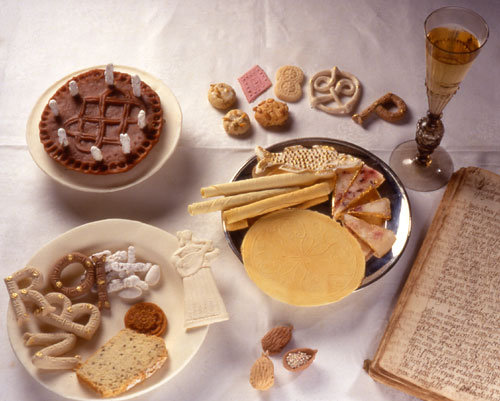
The white hippocras in the Venetian drinking glass in this photograph is served
with a variety of sweetmeats or 'banquetting stuffes'. The wafers (both flat and rolled)
and comfits (white sugar coated spices) were the original accompaniments
to the drink in the context of the medieval void.
During the sixteenth century these were augmented by a vast range of new sugar-based luxury
foods. On the left are 'cinnamon letters according to arte' from John Murrell as well as a
white gingerbread figure. At top left is a quince paste decorated with comfits.
In the 16th century, a banquet was very different from our modern perception and stems from the medieval 'ceremony of the void'. After dinner, the guests would stand and drink sweet wine and spices while the table was cleared, or ‘voided’. (Later in the 17th century ‘void’ would be replaced with the French ‘dessert’.) During the 16th century, guests would no longer stand in the great chamber whilst the table was cleared and the room prepared for entertainment, but would retire to the parlour or banqueting room.
The Renaissance English imported many sugared elements of the Italian dinner into the English dinner, but it was a specialized sweets-centered Italian meal called a collation that particularly gripped the English imagination. Scappi’s twelve collation menus (one for each month) proceed in three courses, the first consisting of candied or syrup-preserved fruits and nuts, sweet biscuits, and marzipan, the second a mélange of pungent savory foods and sweet dishes (similar to the sideboard courses of dinner), and the third the same but also including fresh fruit and Parmesan cheese. Scappi’s collations are not merely meals. They are early-evening parties that are staged in some pretty spot outdoors during the spring and summer months—Scappi suggests a vineyard or a garden—and include a theatrical performance or other entertainment.
The early English banquet, which emerged around 1535 and ran through the death of James I, in 1625, was proclaimed by its participants and cookbook authors as a repast of sugared medicines–that is, essentially an expanded voidee, and as such traditionally (and safely) English. Most privileged English had to content themselves with banqueting in their dining parlors. But, when the occasion demanded, the super-privileged could conduct the affair in a specialized banqueting house.
The bill of fare of the Tudor and Jacobean banquet particularly featured the conceits of the voidee and thereby retained the voidee’s underlying medical justifications. The early banquet always included hippocras and nearly always included wafers, and its most numerous dishes were the nutraceutical conceits of the voidee, namely plain and candied spices and sugared plant materials of all kinds. However, Italian borrowings were numerous, and while most of these had therapeutic value, they strike us today as more geared toward pleasure than cure.
Whole chapters of sixteenth and seventeenth century cookbooks were given over to recipes for ‘banquetting stuffe’. Sugared spices (comfits) and sweetmeats were the earliest delicacies. They were classed as ‘wet’ (in a syrup, like Italian mostarda), or dry (as in crystallised ginger). Over time, sugar became more easily available, and more exotic ingredients were imported and used liberally (rosewater was very popular). Brilliantly coloured and decorated jellies and ‘creams’ (firm custards), small crisp biscuits (similar to macaroons and biscotti), a “white bisket,” essentially hard meringue with anise seeds, gingerbread (which was more like firm fudge than cake), a great deal of marzipan, ‘composts’ (fruit in spiced syrup), and fruit pastes similar to the quince paste we now eat with cheese were all added to the banquet table. Kissing comfits, mentioned in Shakespeare’s Merry Wives of Windsor, were little slips of hard sugar paste imbued with musk, a glandular secretion of an Asiatic deer believed to be an aphrodisiac. A feature of Tudor banquets were 'subtleties' which were made from marzipan or fondant sugar.
Of special importance was the Arabic confection marzipan, a favorite of the Italians since the thirteenth century but unrecorded in England until 1492, where it came to be called marchpane. Any banquet worth its sugar featured a marchpane centerpiece. As typically outlined in period recipes, a marchpane was a thin disc of white-iced marzipan about fourteen inches broad that was decorated with comfits and, on important occasions, surmounted by fanciful sugar statuary. The Tudor and Jacobean English also worked up tinted marchpane as “bacon and eggs” and other cunning knickknacks, and they doted on the new-fangled baked marzipan cakes that the Italians called macaroons.
Gervase Markham in his Country Contentments: the English Huswife, published in 1615, gave over considerable space to the preparation of banquetting stuffe. Amongst the recipes is this early form of iumbals (‘jumbles’ or ‘jumbals’), from the Italian gemello, or twin - a sort of sweet spiced biscuit (in the English sense of the word, which equates to the American ‘cookie.’). Jumbles in England were also sometimes made not from flour, eggs and butter, but from a sugar and fruit paste, or almond meal, very much resembling the marzipan biscuits of Platina. ‘Apricock Jumballs’ from an 18th century recipe from ‘English Housewifery Exemplified’ written by Elizabeth Moxon is such a flourless jumble, consisting only from sugar and apricots cooked until they become a stiff paste like fruit cheese. These were then cut in strips and made into complex knot creations which you can see in some Dutch still life paintings.
"To make the best Iumbals, take the whites of three egges and beat them well and take of the viell; then take a little milke and a pound of fine wheat flower and suger together finely sifted, and a few Aniseeds well rubd and dried; and then work all together as stiffe as you can work it, and so make them in what forms you please and bake them in a soft oven upon white Papers."
-- Gervase Markham, Country Contentments: the English Huswife, published in 1615
Rounding out the fare of the early banquet were several sweets that had long been part of elite English fare. These included the highly esteemed sweetened animal gelatins, called jellies, which typically consisted of a clarified calves’-foot stock flavored with spices and wines and/or citrus juice. Calves-foot jellies were sometimes colored and, in palaces, they were fancifully molded and turned out, but most banqueters encountered them as described in a banqueting cookbook of 1608, “cut . . . into lumps with a spoone.” There was also a specialized jelly called leach (from a French word meaning slice), which was creamy and rose-water-scented and was set with the new-fangled isinglass, made from sturgeon swim bladders.
A favorite banqueting stuff “used at the Court and in all Gentlemen’s houses at festival times,” as Hugh Plat wrote in Delights for Ladies, his banqueting cookbook of 1609, was gingerbread. The common sort, called colored gingerbread (because it was typically tinted rusty-red with ground sandalwood), was made by boiling bread crumbs, wine or ale, sugar and/or honey, and an enormous quantity of diverse spices into a thick paste, which was then printed in elaborate molds and dried to a chalky-chewy consistency. Colored gingerbread originated as a medicine, and it tastes like one: its spicing is almost caustic. In the late seventeenth century, as the banquet petered out, colored gingerbread waned, its name assumed by early forms of today’s baked molasses gingerbread, which came to England from the Netherlands or France.
As the idea of banqueting developed, it could take place at any time during the day and have much more in common with the later practice of taking tea. Banqueting rooms varied greatly from house to house, but were generally on an intimate scale, either in a garden room or inside such as the small banqueting turrets in Longleat House. In the early 18th century, banqueting houses were built for enjoying fresh fruit, jellies, and puddings.
At an election dinner in 1560, the following were served for the banquet course: 'spice bread [gingerbread made with breadcrumbs], cherries, strawberries, pippins, and marmalade, and sukett, comfits, and portyngalles (currant cakes spiced with mace) and divers other dishes, hippocras, Rhenish, claret wine and beer and all great plenty.'
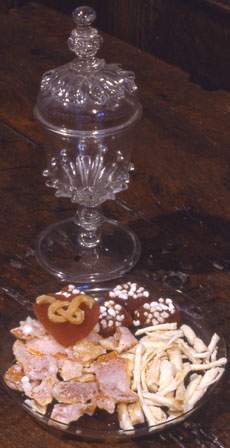
The hippocras in the covered wine cup is
served here with sweetmeats, including
quince marmalade struck with Spanish
comfits. The white roots on the right are
the popular aphrodisiacal candied eryngo.
List of "Banquetting Stuffe"
Comfits (sugar-coated spice seeds)
Suckets (candied fruit peel)
Wet sweetmeats in syrup
Dry sweetmeats, such as crystallised ginger
Brilliantly colored and decorated jellies and custards
Wafers
Small biscuits (See Regency Biscuits)
Cinnamon Letters According to Arte (from John Murrell)
Gingerbread
Marchpane
Composts
Fruit pastes (quince, peach, green pippins) See Quince Paste
By 1500, cream, cheese and savouries also began to feature.
Note on Composts: Ayto (1993) remarks that both compote and compost are derived from the past participle of the verb componere (to bring together). In Old French composte was used for a dish of fruit stewed in syrup; and this usage was followed for a time in England, e.g. in a 15th century recipe for 'pears in compost.' C. Anne Wilson (1973) observes that this is one dish where the transition from honey to sugar as the sweetener can be traced, honey and spices having been used in the original compost, 'which was kept and eaten cold as a sort of winter salad,' but replaced by a sugar and wine syrup in the 15th century.
Gervase Markham (The English Huswife, 1615) wrote a brief section on "The Ordering of Banquets" wherein he describes an ideal dessert course.
"...I will now proceed to the ordering or setting forth of a banquet; wherein you shall observe that the marchpanes have the first place, the middle place, and the last place; your preserved fruits shall be dished up first, your pastes next, your wet suckets after them, then your dried suckets, then your marmalades and goodinyakes, then your comfits of all kinds; next, your pears, apples, wardens baked, raw or roasted, and your oranges and lemons slices; and lastly your wafer cakes."
He continues by saying that this is the order in which to organize them prior to sending them out to the dining hall. When the diners are ready, "dish made for show only" precedes everything.
