Types of Cookies
Cookies can be broadly classified according to how they are formed, including at least these categories. For more recipes, see the main Cookies page.
Also see:
Italian Cookies
German Christmas Cookies
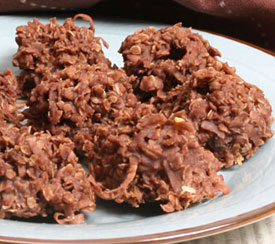
No-Bake Cookies
Another of the easy types of cookies, no bake cookies are a great way for kids to get started in the kitchen. As the name indicates, these cookies are not baked. Ingredients are often heated on the stovetop and then mixed with bulkier items, such as oatmeal, chow mein noodles, coconut, nuts and boxed cereal.
No bake cookies are also good on hot summer days when you don't want to turn the oven on.
Examples are Chocolate No Bake Cookies, Chocolate Butterscotch No-Bakes, and Rice Krispies Treats.
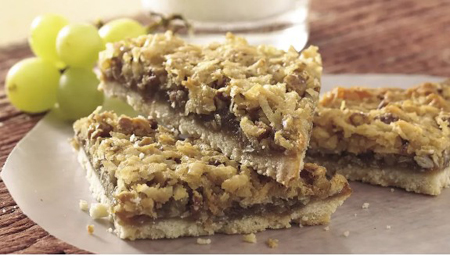
Bar Cookies
These are the quickest and easiest type of cookie to make. Here, batter or other ingredients are poured or pressed into a rectangular pan (sometimes in multiple layers), then baked and cut into individual-sized squares. In the U.K., bar cookies are known as “tray bakes.”
Examples of bar cookies:
Brownies
Mom's Pecan Coconut Bars
Susan's Lemon Squares
Mom's Oatmeal Date Bars
Mom's Pumpkin Raisin Bars
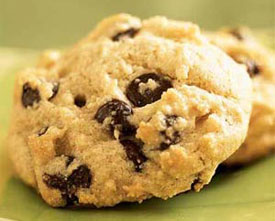
Drop Cookies
The most popular types of cookies, created by dropping cookie dough from a teaspoon or tablespoon onto a prepared cookie sheet. Just mix, drop, bake, and enjoy -- definitely an easy cookie type.
A drop cookie is a relatively soft dough and during baking, the mounds of dough spread and flatten. Depending on the cooking time and recipe, it can be a soft and chewy or crisp and hard cookie.
Chocolate Chip Cookies, Coconut Macaroons, Oatmeal Cookies, and Old Fashioned Molasses Cookies are examples of traditional drop cookies.
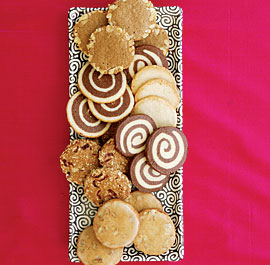
Refrigerator Cookies or Ice Box Cookies
Refrigerator cookies are sometimes called ice box cookies. Made from a stiff dough that is rolled into "logs" and refrigerated; it can even be frozen. It is then sliced into rounds and baked. These cookies are a convenient way to have fresh baked cookies. They can be made in advance and refrigerated or frozen and baked just a few at a time if desired. They first appeared in cookbooks in 1920.
Almost any cookie dough can be shaped and chilled before baking, but certain high-butter recipes work extremely well with this method. Some of the most common recipes are sugar cookies, butter cookies, shortbread, pinwheels and korova cookies.
Refrigerator Cookies
Mom's Refrigerator Oatmeal Cookies
Pecan Refrigerator Cookies
Date Nut Icebox Cookies
Hand Shaped Cookies
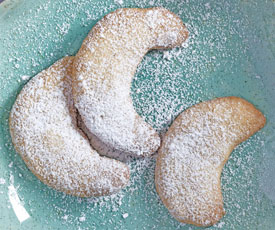
These cookies are made from a stiffer dough that is molded into balls or other shapes (wreaths or crescents, for example) before baking. The stiffer dough allows them to be shaped by hand. Peanut Butter Cookies, Thumbprints, Almond Crescents and Snickerdoodles are examples of cookies shaped by hand.
Tea Cakes are one type of hand shaped cookie. A tea cake is a butter shortbread-type cookie made with powdered sugar instead of regular sugar and is also dusted with it. Classic "tea cakes" are Mexican Wedding Cakes, also called Russian Tea Cakes, Florentine Wedding Cakes and Louisiana Pecan Balls.
Another type of hand shaped cookies, similar to tea cakes are Meltaways. Meltaways replace some of the flour with cornstarch (corn flour) so the cookies literally "melt-in-your-mouth". These are often confused with tea cakes because meltaways are often rolled in confectioner's sugar and look like tea cakes. At other times the dough is placed in a piping bag with a fluted tip and then piped into rosettes. A traditional finishing touch is to top each cookie with a red or green candied cherry. Other times the dough is rolled into a crescent shape with the ends sometimes dipped in melted chocolate. Two meltaway recipes are Melting Moments and Chocolate Mint Melt-Aways.
Rolled Cookies (Cut-outs)
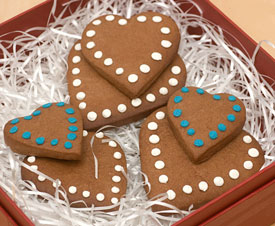
Made from a stiffer dough that is chilled and then rolled out and cut into shapes with a cookie cutter, knife or pastry wheel. Gingerbread men are an example (or any cookie made with a cookie cutter).
See Holiday & Other Cutouts on the main Cookies page for recipes
Also see History of Cut-out Cookies
Pressed Cookies
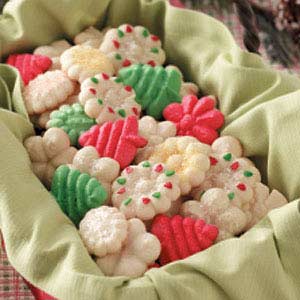
Made from a soft dough that is extruded from a cookie press (cookie gun) or pastry tube into various decorative shapes. Spritz cookies are an example.
Molded and Stamped Cookies
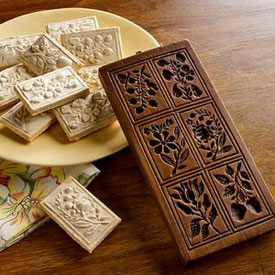
Cookie molds and stamps were the precursors to cookie cutters. Since Medieval times, Gingerbread was pressed using a rolling pin into what are called "cavity" molds. When the cookie was removed, it retained the design of the mold. These molds work best with dough that is sweetened with honey, or in which the sweetener is at least 50% a liquid such as honey.
Impression molds are pressed down onto the dough and can be used with more fragile and delicate doughs. Springerle, traditional German cookies, are imprinted with a design using either a Springerle rolling pin or cookie stamps. Scottish shortbread is often baked in a cookie mold.
Cookie stamps are used to imprint a design on a single cookie at a time. The dough is often rolled into balls and then pressed down with the stamp, leaving its design.
Other cookies that use molds are the French Madeleines (small sponge cake cookies) and Chocolate-Filled Walnut Cookies.
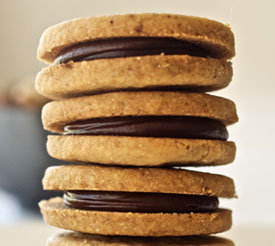
Sandwich Cookies
A sandwich cookie is simply two cookies of any type, joined together with a filling. The most famous sandwich cookies are Oreos, but there are numerous other traditional sandwich cookies, from Nutter Butters to a variety of vanilla, chocolate and lemon creme sandwich cookies to whoopie pies. French Macarons, two macarons filled with a layer of ganache, are perhaps the most elegant example.
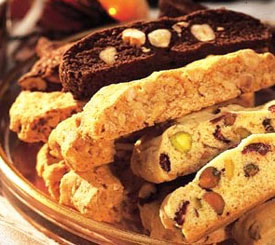
Biscotti
Twice Baked Cookies
Originally made as a long-shelf-life food for travelers and carried by the Roman Legions, today's biscotti are a popular accompaniment to cappuccino and a classic with Vin Santo.
First, the sticky dough is shaped into a log and baked until firm. After a short cooling period, the log is sliced into diagonal slices and baked again to cook out the moisture and produce the crisp, dry-textured cookie with a longer shelf life.
The classic recipe has no butter or oil, using only eggs to bind the ingredients together. Recipes that do use butter or oil have a softer texture and a shorter shelf life.
Most European countries have adopted their own version of biscotti. The British have rusks; the French, biscotte and croquets de carcassonne; Germans, zwieback; Greeks, biskota and paxemadia; Jews, mandelbrot; and Russians, sukhariki.
Recipes:
Italian Anisette Cookies (Biscotti)
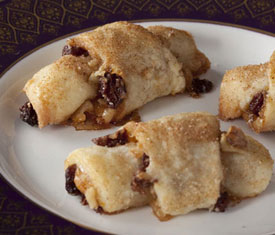
Jewish Rugelach
Yeast Cookies
A variety of cookies have traditionally been made with yeast. One is the Jewish Rugelach; Polish Kolaczki is another. Modern versions of these cookies are usually made with a cream cheese pastry instead.
Recipes:
Kolaczki (Polish pastry-type Holiday cookies)
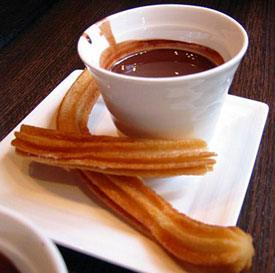
Mexican Churros served with chocolate dipping sauce
Fried Cookies
A fried cookie is simply fried dough, often dusted with powdered sugar. Examples include the Jewish/Polish Krusczyki, the Italian Zeppole and Cròstoli, Mexican churros and Norwegian Rosettes.
Fried dough is becoming increasingly popular, with chocolate chip cookie dough, oatmeal cookie dough and others all tossed into the fryer. Churros and other classic fried cookies are also finding their way onto the dessert menus of fine restaurants, served with chocolate dipping sauce.
Recipes:
Krusczyki (Polish Xmas Cookie)
Norwegian Rosettes (requires Rosette iron)
Italian Cannolis
Struffoli (Italian Honey Balls)
Crostoli (Italian fried cookie)
Italian Zeppole
Mexican Churros
